The Meroitic script was the indigenous writing system developed and used by the later phase of the Kingdom of Kush, especially during its Meroitic period, which lasted roughly from 300 BCE until about 350 CE. This script is most strongly associated with the royal and urban center of Meroë, located in present-day Sudan. Its emergence represents a significant cultural milestone because it demonstrates that the Kushites developed a fully independent written tradition rather than relying permanently on earlier foreign systems such as Egyptian hieroglyphs, which had previously influenced the region for centuries.
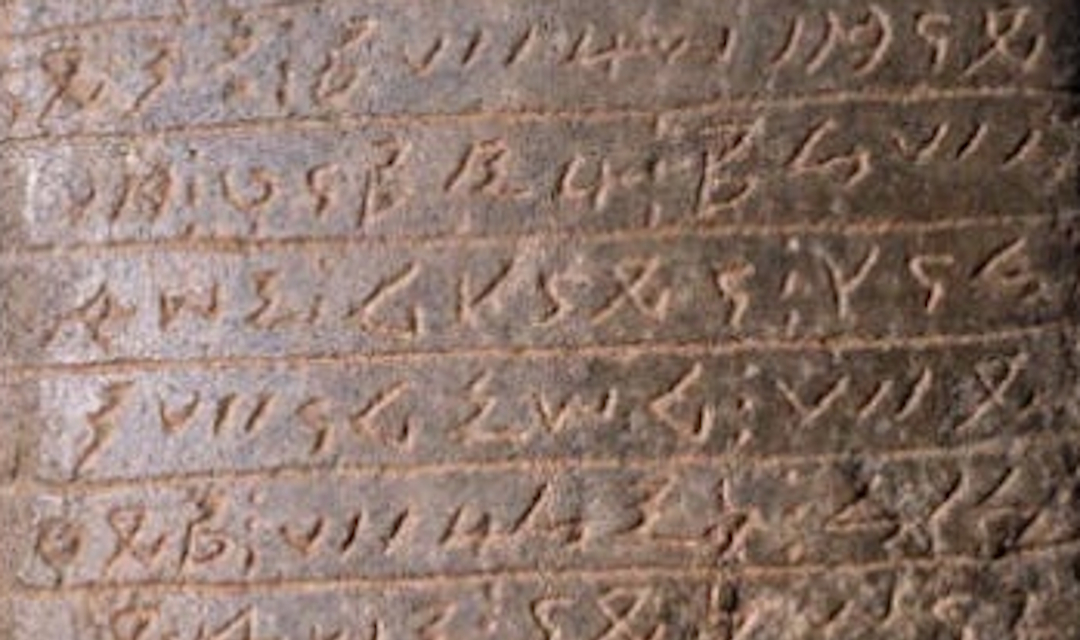
From a structural perspective, the Meroitic script is now well documented in terms of its physical signs and writing mechanics. It consists of approximately twenty-three basic characters, which function in a system that scholars often describe as an alphasyllabary. This means that the script does not operate purely as an alphabet in the modern sense, nor as a purely syllabic system, but instead combines features of both. Some symbols represent individual consonant sounds, while others represent syllabic units that include an inherent vowel. The script developed in two visually and functionally distinct forms: a hieroglyphic form, which was used primarily for monumental inscriptions carved into stone and associated with religious or royal contexts, and a cursive form, which was written with ink and used more widely in administrative, funerary, and everyday communication. The cursive form is the most frequently preserved in archaeological finds and is generally written from right to left, although minor variations in direction occasionally appear depending on context or medium.
One of the most important achievements in modern scholarship is that researchers have been able to reconstruct the approximate phonetic values of the Meroitic signs. This breakthrough was achieved primarily through comparative analysis with inscriptions written in Egyptian hieroglyphs, especially in cases where both writing systems refer to the same individuals, places, or royal titles. By identifying proper names and matching them across languages, scholars were able to assign consistent sound values to many Meroitic symbols. As a result, it is now possible to read Meroitic texts aloud with a reasonable degree of confidence. For example, the names of Kushite rulers such as Taharqa can be recognized phonetically in inscriptions. However, this achievement should not be confused with full comprehension, because the ability to pronounce a text does not automatically provide access to its meaning.
Despite this progress in phonetic decipherment, the semantic and grammatical understanding of the Meroitic language remains limited. Scholars have identified a number of recurring words and formulaic expressions, particularly in funerary inscriptions and temple dedications. These often appear in highly structured and repetitive contexts, which suggests that they may relate to religious invocations, royal titles, offerings to deities, or standard funerary blessings. Linguists have also observed patterns in word endings and sentence structure, which has led to the hypothesis that the language may use suffixes or other morphological markers to indicate grammatical relationships such as possession, subject-object structure, or plurality. Nevertheless, these interpretations remain tentative, and much of the vocabulary has not been securely translated. In many cases, meanings are inferred indirectly through context, repetition, and archaeological setting rather than through direct bilingual evidence.
The underlying spoken language represented by the script, known as the Meroitic language, is itself still not fully classified within any well-established language family. Some researchers have proposed that it may be related to the broader Nilo-Saharan language family, which includes several languages spoken in parts of northeastern and central Africa. However, this hypothesis remains debated, and no definitive linguistic consensus has been reached. The difficulty arises largely because there are no closely related ancient languages with sufficiently well-preserved written records that could serve as reliable comparison points. This isolation makes Meroitic a particularly challenging case for historical linguistics.
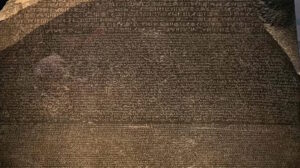
A major obstacle in fully deciphering the script is the absence of a bilingual inscription comparable to the Rosetta Stone, which played a crucial role in the decipherment of Egyptian hieroglyphs. In the case of Meroitic, no surviving artifact presents the same text in both Meroitic and a known language such as Greek or Egyptian.
Alongside what scholars can reconstruct scientifically, the Meroitic script also carries a layer of historical “storytelling” that comes from interpretation, archaeology, and educated assumptions about the world of the Kingdom of Kush. Because the texts are often fragmentary and only partially understood, historians sometimes have to imagine the human situations behind them based on context, location, and repeated formulas.
One of the most interesting “stories” comes from funerary inscriptions found around Meroë. Many tomb texts follow a highly structured pattern that appears to ask for protection or blessings for the deceased. Even though we cannot translate every word with certainty, the repetition suggests a strong belief in an organized afterlife. Archaeologists assume that these inscriptions were not just decorative, but part of a broader religious system in which written language itself had protective or magical power. In other words, writing was not only communication, but also something that could influence the spiritual world.
Another fascinating interpretation comes from royal inscriptions connected to rulers such as Taharqa and other Kushite kings and queens. Some inscriptions appear in temples that show clear influence from Egyptian hieroglyphs, yet they are written in Meroitic language. From this, historians assume that Kushite rulers were consciously presenting themselves as both heirs to Egyptian royal tradition and as independent African monarchs. This dual identity suggests a political strategy: using familiar symbols of power while maintaining a distinct cultural identity.
There are also intriguing assumptions about how writing itself may have been used in daily life. Although most surviving texts come from monuments and tombs, scholars believe that the Meroitic script was also used for administration, trade records, and possibly private communication. Because the city of Meroë was a major center of iron production and long-distance trade, it is likely that written records helped manage goods, taxes, and commercial exchange. The absence of such documents today is probably due to the fragile materials used, such as papyrus or wood, which did not survive the climate of present-day Sudan.
One of the most striking “missing stories” is the voice of ordinary people. We mostly see kings, queens, priests, and elite burial practices. However, historians assume that the development of a fully native writing system implies a literate class—scribes, administrators, and temple workers—who used writing in practical ways. This suggests that Meroë was not only a royal capital but also a functioning bureaucratic society where writing played a role in organizing everyday life, even if those records have not survived.
A major interpretive idea among scholars is that the Meroitic script represents a cultural shift from external influence to internal expression. Earlier Kushite writing relied heavily on Egyptian models, but the Meroitic system signals a deliberate move toward linguistic independence. This has led some researchers to argue that the script reflects a broader political and cultural confidence during the later Kingdom of Kush, when it was no longer simply in Egypt’s shadow but acting as a regional power in its own right.
The decline of the script around the fall of the Kingdom of Kush around the fourth century CE also raises interpretive questions. After the political collapse, the writing system disappeared completely and was never replaced in the same form. Historians assume that this was not simply a loss of writing technology, but part of a deeper cultural transformation, possibly linked to changes in religion, trade routes, and political structure in northeastern Africa.
In conclusion, what we “know” about Meroitic is a combination of hard linguistic evidence and carefully built historical interpretation. We can read its sounds, identify its structure, and recognize its archaeological contexts, but we cannot fully translate its messages. At the same time, the patterns we do see allow scholars to reasonably assume that it recorded religion, royal authority, administration, and aspects of daily life in the Kingdom of Kush. The script therefore stands in a unique position in world history: it is not completely lost, yet not fully revealed, preserving both knowledge and mystery at the same time.
Meroitic inscription and show how scholars analyze it step by step.
For a example, well-known funerary text type from tomb stelae found around Meroë. Many inscriptions are similar in structure, even if individual words are not fully understood.
The inscription (transliterated form)
A typical Meroitic funerary inscription looks like this in scholarly transliteration:
“wi-te-she qore-l-ḥo ḳe r qe-s”
(Exact spelling varies slightly by inscription)
Important note: this is not translation yet—it is just sound-based reading of the Meroitic script.
Step one: reading the sounds
The first thing scholars do is convert symbols into sounds:
- wi-te-she
- qore
- ḳe
- r
- qe-s
At this stage, we are not interpreting meaning—only pronouncing what is written, based on phonetic reconstruction.
This is possible because of comparisons with Egyptian hieroglyphs, especially names of rulers and places.
Step two: identifying possible “known words”
Researchers then look for repeated patterns across many inscriptions.
They notice:
- “qore” appears very frequently
- It appears in royal contexts and tombs
So scholars hypothesize:
- “qore” may mean something like “king” or “ruler”
This is not fully proven, but it is strongly supported by context.
Step three: understanding the context
This type of inscription is found on a tomb. That immediately tells scholars:
- It is likely funerary text
- It probably includes:
- Name of the deceased
- Title (king, noble, priest, etc.)
- A blessing or protective formula
- A reference to gods or afterlife
So even without full translation, context gives structure.
Step four: breaking grammar patterns
Scholars notice repeated endings like:
- “-s”
- “-l”
- repeated short particles like “qe”
These are interpreted as possible:
- grammatical endings
- connectors (“of”, “to”, “for”)
- or ritual formula markers
But again: meaning is inferred, not confirmed.
Step five: building a probable meaning
After comparing dozens of similar inscriptions, scholars propose a tentative reconstruction such as:
“(Name), the qore (ruler), [blessing formula], may he/she be protected…”
But important:
- This is not a direct translation
- It is a best-fit interpretation based on repetition and archaeology
What scholars are confident about
From inscriptions like this, researchers can say with confidence:
- The text is funerary
- It refers to a person of status
- “qore” likely indicates a ruler or elite title
- The structure is formulaic and standardized
- It reflects belief in afterlife protection
What remains uncertain
Even after decades of study:
- We cannot fully translate every word
- Grammar is still partly unknown
- Some words appear only once in the entire corpus
- The full sentence meaning is often reconstructed, not proven