
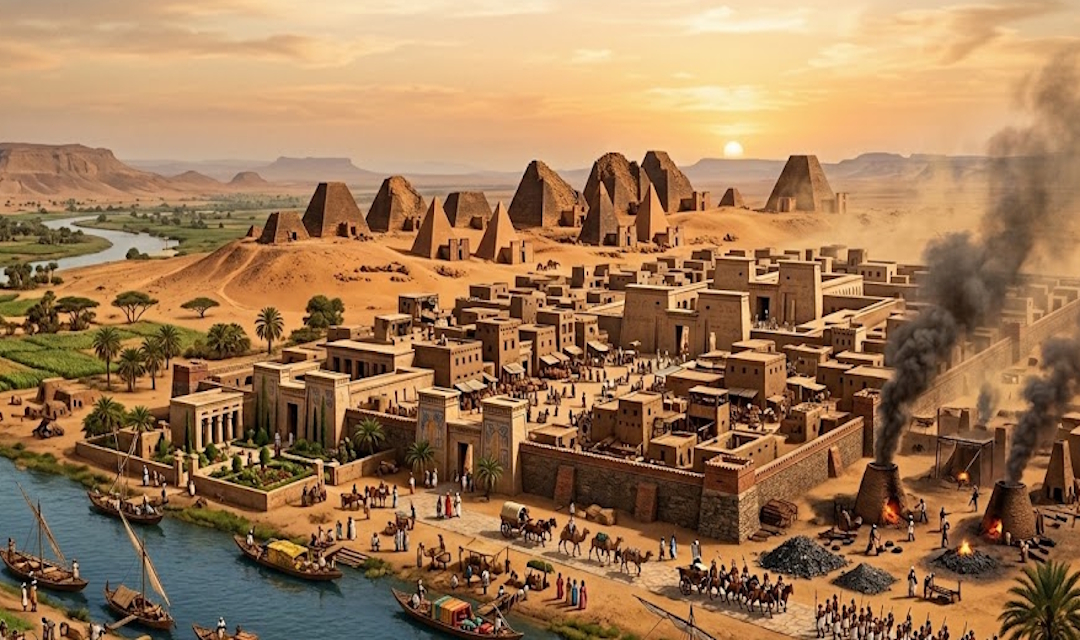
The Kingdom of Kush stands as one of the most formidable and sophisticated empires in ancient African history, flourishing for over a thousand years in the region of Nubia, which encompasses modern-day Sudan. Far from being a mere imitation of its northern neighbor, Egypt, Kush developed a distinct and powerful cultural identity characterized by its extraordinary architectural achievements, a specialized iron-working economy, and a unique political system that frequently placed women at the helm of the state. Its history is a testament to the complex trade networks and military prowess that defined the Nile Valley, serving as a vital bridge between the Mediterranean world and the interior of the African continent.
The civilization’s timeline is generally categorized into three distinct eras, each defined by its capital city. The earliest, Kerma, was a powerful city-state that rose to prominence around 2500 BCE. The people of Kerma were renowned for their refined pottery and the construction of massive mud-brick structures known as Deffufas. During the subsequent Napatan period, Kush reached its political zenith. In the 8th century BCE, the Kushite King Piye successfully invaded and unified Egypt, establishing the 25th Dynasty. For nearly a century, these “Black Pharaohs” ruled an empire that stretched from the shores of the Mediterranean to the confluence of the Blue and White Nile rivers, revitalizing Egyptian traditions while maintaining their own Nubian heritage.
As the empire transitioned its capital to Meroë around 590 BCE, it entered a golden age of industry and indigenous innovation. Meroë became a world-renowned center for iron production, utilizing the region’s vast ore deposits to forge tools and weapons that revolutionized agriculture and warfare. It was during this time that the Kushites developed the Meroitic script, an alphabet that replaced Egyptian hieroglyphs with a system better suited to their own language. Perhaps most notably, the Meroitic era was the age of the Kandakes, or Queen Mothers. These powerful women were not merely figureheads; they were sovereign rulers and military commanders who famously led their armies to resist the expansion of the Roman Empire, securing favorable peace treaties that preserved Kushite independence for centuries.
The visual legacy of the Kingdom of Kush is most strikingly preserved in the pyramids of Meroë and Jebel Barkal. While inspired by Egyptian funerary practices, the Kushite pyramids possess a unique aesthetic, characterized by their steep angles, smaller bases, and decorative pylon entrances. There are more standing pyramids in Sudan today than there are in the entirety of Egypt, serving as a silent reminder of the empire’s vast wealth and its devotion to the divine. This wealth was fueled by the “Land of the Bow,” as the region was known, producing elite archers and controlling the flow of gold, ivory, and exotic goods that were highly coveted across the ancient world.
The eventual decline of Kush in the 4th century CE was likely the result of a combination of environmental and economic factors. The massive demand for charcoal to fuel iron furnaces led to widespread deforestation, while the rise of the neighboring Kingdom of Aksum in Ethiopia shifted trade routes away from the Nile. Despite its eventual fall, the Kingdom of Kush remains a pillar of African history. It was a civilization that did not just survive in the shadow of giants, but often dictated the terms of trade, religion, and war in the ancient world, leaving behind a legacy of resilience and intellectual achievement that continues to be uncovered by archaeologists today.
Diplomatic Brinkmanship
The Kingdom of Kush was a master of diplomatic brinkmanship, often utilizing a sophisticated combination of military intimidation and strategic negotiation to maintain its sovereignty against the world’s most aggressive superpowers. Rather than existing as a passive neighbor to the north, the Kushites actively engaged in the high-stakes geopolitics of the Mediterranean and Near East, ensuring that their voice was heard in the courts of emperors and pharaohs alike. This diplomatic agility allowed them to survive for over a millennium, even as other contemporary empires rose and fell around them.
One of the most significant examples of this brinkmanship occurred during the late eighth century before the common era, when the Kushite King Piye observed the political fragmentation of Egypt. Recognizing a vacuum of power, he launched a calculated invasion that was as much a diplomatic mission as a military one. By presenting himself as a traditionalist who sought to restore the ancient religious order of Amun, he successfully convinced many Egyptian elites to defect or remain neutral. This clever branding allowed him to unify the Nile Valley under the Twenty-Fifth Dynasty, effectively turning a conquest into a perceived liberation and cementing Kushite authority for nearly a century.
The relationship between Kush and the Roman Empire provides perhaps the most dramatic illustration of their diplomatic skill. After the Romans annexed Egypt in thirty before the common era, tensions escalated as the Roman prefects attempted to impose taxes and military control over the northern reaches of Nubia. In a bold act of defiance, the Kandake Amanirenas led an army into Roman territory, capturing several cities and toppling statues of the Emperor Augustus. This was not a mindless act of aggression, but a calculated risk designed to force the Romans to the negotiating table from a position of strength.
The outcome of this conflict was the Treaty of Samos in twenty-one before the common era, a remarkable document that demonstrated Kushite diplomatic victory. Through intense negotiation, the Kushite envoys secured a peace that was almost unheard of in the Roman world. The Emperor Augustus agreed to waive the tribute previously demanded of the kingdom and established a clear, respectful border between the two powers. This treaty ensured that Kush would remain an independent and tax-exempt state, a status that allowed the kingdom to flourish as a trade hub for several more centuries while the Roman legions generally avoided further southern expansion.
Furthermore, the Kushites utilized their economic resources as a primary lever in international relations. By controlling the flow of gold, ivory, and iron from the African interior, they made themselves indispensable trading partners to both the Greeks and the Assyrians. They often played rival powers against one another, ensuring that no single foreign entity could gain a monopoly over their markets or their territory. Through this careful balancing of trade, military readiness, and sharp-witted negotiation, the Kingdom of Kush secured its place as a formidable and respected sovereign power in the ancient world.
The specific military tactics of the Kushite archers, and perhaps the unique religious practices
The military and religious identity of the Kingdom of Kush was defined by a fierce sense of independence and a deep connection to the natural power of the African landscape. While they respected the traditions of the Nile, the Kushites developed specific martial techniques and deities that reflected their own environment and cultural values. By examining the precision of their archers alongside the worship of the lion-god Apedemak, one can see a civilization that balanced disciplined strategy with a potent, warrior-centric spirituality.
The military reputation of Kush was built primarily upon the legendary skill of its bowmen. For millennia, the Egyptians referred to the region as “Ta-Seti,” which translates to the “Land of the Bow.” This was not merely a poetic title but a recognition of a specialized military class that was feared across the ancient Near East. Kushite archers utilized a powerful composite bow, often constructed from reinforced wood and horn, which allowed for greater range and penetration than the simpler bows used by many of their contemporaries.
The tactics of these archers were centered on extreme accuracy and high-volume fire. Rather than relying solely on massed infantry charges, Kushite commanders used their archers to thin enemy ranks and decapitate leadership from a distance. Historical accounts from the Roman invasion of Nubia suggest that Kushite archers were specifically trained to aim for the eyes of their opponents, a terrifying psychological tactic that caused significant distress among the Roman legions. Furthermore, they utilized poisoned arrows and specialized thumb rings made of stone or metal to increase the speed and comfort of their release, allowing a single archer to maintain a rapid and deadly rate of fire during prolonged engagements.
While the Kushites adopted the worship of the Egyptian god Amun, they reserved their most fervent devotion for Apedemak, an indigenous lion-headed deity who personified the military might of the Meroitic state. Unlike the more aloof and solar-focused gods of the north, Apedemak was a god of the soil and the sword. He was frequently depicted as a robust man with the head of a snarling lion, often wearing heavy armor and wielding a bow or leading a captive enemy by a rope. This imagery sent a clear message: the King of Kush derived his authority from a god of raw, predatory power.
The worship of Apedemak reached its peak in the great temples of Musawwarat es-Sufra and Naqa. In these sacred spaces, Apedemak was sometimes portrayed in a unique “multi-armed” form or as a serpent emerging from a lotus flower with a lion’s head, suggesting a complex theology that blended creation with destruction. He was the protector of the Kandakes and Kings, and it was believed that his favor ensured the success of the iron-smelting furnaces and the fertility of the southern rains. By centering their state religion on a fierce local predator, the Kushites signaled their cultural departure from Egypt, branding themselves as the undisputed masters of the southern wild.
The Mastery of Kushite Gold and Jewelry
The Kingdom of Kush was synonymous with gold. The region of Nubia actually derives its name from the ancient Egyptian word “nub,” meaning gold. For the Kushite royalty, jewelry was more than mere decoration; it was a potent symbol of divine favor and political legitimacy. Kushite goldsmiths were arguably the most skilled in the Nile Valley, mastering complex techniques such as granulation, filigree, and cloisonné enamel long before they became common in other Mediterranean cultures.
The most famous collection of these treasures belonged to the Kandake Amanishakheto. Her hoard included massive gold signet rings, intricate hinged bracelets, and elaborate pectorals adorned with images of the goddess Mut and the ram-headed Amun. Unlike the thinner gold leaf often found in other cultures, Kushite jewelry was frequently cast from solid gold and inlaid with semi-precious stones like carnelian, lapis lazuli, and turquoise. These pieces often featured a blend of Egyptian motifs—such as the winged sun disk—with distinctly African iconography, including Nile crocodiles and indigenous floral patterns, creating a style that was uniquely “Meroitic.”
Environmental Overreach and the Iron Crisis
The same technological prowess that made Kush wealthy also contained the seeds of its destruction. As Meroë became a global superpower in iron production, its landscapes began to transform. To smelt iron, the Kushites required massive amounts of charcoal, which could only be produced by burning the vast acacia and savanna woodlands that surrounded their cities. Over centuries, this insatiable demand for fuel led to catastrophic deforestation.
Without the protection of tree cover, the topsoil was quickly eroded by the seasonal rains and winds, leading to a decline in agricultural productivity. The land could no longer support the large populations required to maintain a centralized empire. Furthermore, as the trees vanished, the climate in the immediate vicinity of the cities became harsher and drier. By the time the Kingdom of Aksum rose to prominence to the east, the environmental foundation of Kush was already crumbling. The once-green plains surrounding Meroë had turned into the arid landscapes we see today, forcing the population to disperse and eventually lead to the total abandonment of the royal cities.
The Legacy of the Desert
Today, the golden artifacts of the Kandakes are housed in museums around the world, serving as a testament to a civilization that reached the pinnacle of craftsmanship. Meanwhile, the ruins of the iron furnaces and the sand-swept pyramids of Meroë stand as a silent warning about the delicate balance between industrial advancement and environmental stewardship. The fall of Kush was not just a military or economic event, but a profound ecological shift that ended one of Africa’s most brilliant chapters.
