
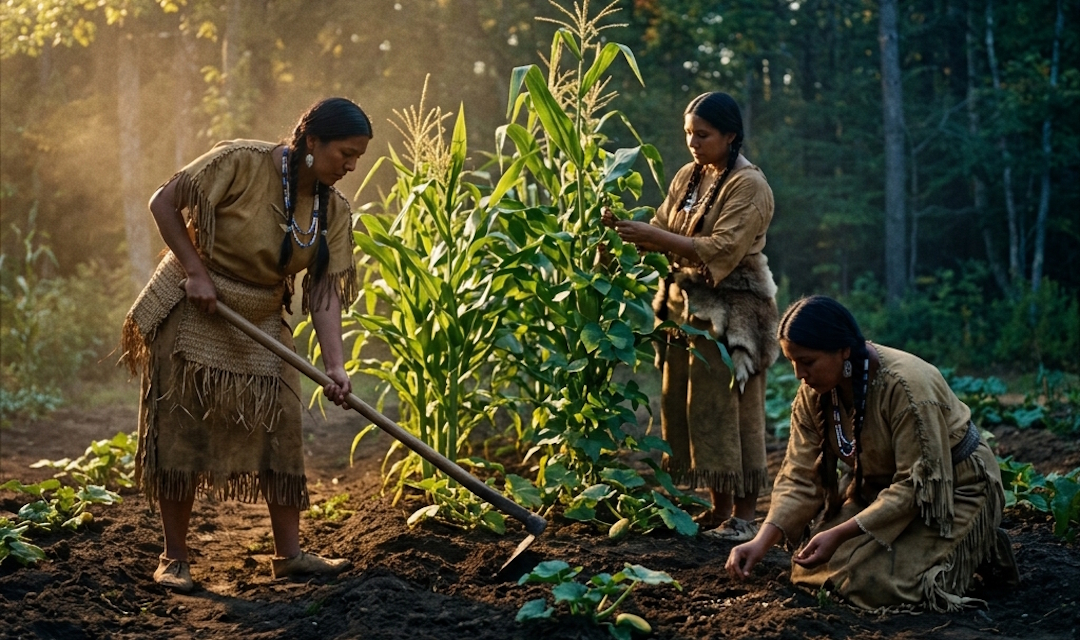
Long before European ships appeared on the coasts of the Americas, Indigenous societies had already developed sophisticated agricultural systems capable of sustaining large populations, complex political structures, and thriving trade networks. These systems were not primitive or accidental—they were the result of centuries of observation, experimentation, and deep ecological knowledge. Agriculture in the Americas was diverse, regionally adapted, and often far more sustainable than many early European practices. It allowed Indigenous communities not only to survive, but to build cities, maintain social hierarchies, and shape entire landscapes according to their needs.
One of the most important features of Indigenous agriculture was its adaptability. Unlike European farming, which often relied on uniform methods and monoculture, Indigenous systems were tailored to specific environments. In the eastern woodlands of North America, communities developed the famous “Three Sisters” method—growing maize, beans, and squash together in the same plot. This was not just convenient; it was scientifically efficient. Maize provided a structure for beans to climb, beans fixed nitrogen in the soil, and squash covered the ground, reducing weeds and retaining moisture. This intercropping system increased yields while preserving soil fertility, allowing fields to remain productive for long periods without the need for artificial fertilizers.
In Mesoamerica, agricultural innovation reached an even higher level of complexity. Civilizations such as the Aztecs developed chinampas—artificial islands built in shallow lakes. These “floating gardens” were constructed using layers of mud, vegetation, and organic matter, creating extremely fertile soil. Chinampas could produce multiple harvests per year and supported dense urban populations, including the massive city of Tenochtitlan. This system demonstrated a deep understanding of water management, soil science, and crop cycles. It was not only productive, but also remarkably sustainable, recycling nutrients and minimizing environmental degradation.
In the Andes, Indigenous farmers developed terrace farming to overcome the challenges of mountainous terrain. By carving step-like fields into steep slopes, they prevented soil erosion, retained water, and created microclimates suitable for different crops. Civilizations such as the Inca cultivated potatoes, quinoa, and maize at various altitudes, using sophisticated irrigation systems to distribute water efficiently. These terraces transformed otherwise unusable land into highly productive agricultural zones and allowed for the support of large, organized societies in one of the most challenging environments on Earth.
Another critical aspect of Indigenous agriculture was biodiversity. Rather than relying on a single crop, Indigenous farmers cultivated a wide variety of plants, including maize, beans, squash, potatoes, tomatoes, peppers, cacao, and tobacco. This diversity reduced the risk of total crop failure and ensured a more balanced diet. It also contributed to resilience against pests, diseases, and climate variability. Many of these crops would later become staples of global agriculture after their introduction to Europe, Asia, and Africa.
Indigenous agricultural systems were also deeply integrated with environmental management. Practices such as controlled burning were used to maintain open landscapes, encourage the growth of certain plants, and improve hunting conditions. Far from being destructive, these fires were carefully managed to enhance biodiversity and prevent larger, uncontrolled wildfires. In many regions, what European settlers perceived as “untouched wilderness” was actually a landscape that had been actively shaped and maintained by human activity for generations.
Food storage and preservation were equally advanced. Indigenous communities developed methods such as drying, smoking, fermenting, and underground storage to ensure a stable food supply throughout the year. Maize, for example, could be dried and stored for long periods, while techniques like nixtamalization (treating corn with alkaline substances) improved its nutritional value. These practices allowed communities to survive seasonal shortages and support larger populations without constant access to fresh harvests.
Trade networks played a significant role in distributing agricultural products across vast distances. Goods such as maize, dried fish, salt, and cacao were exchanged between regions, creating interconnected economies. These networks facilitated not only the movement of food, but also the exchange of knowledge, technologies, and cultural practices. Agriculture was therefore not an isolated activity—it was part of a broader system that connected communities across the continent.
Social organization was closely tied to agricultural production. In many societies, farming was a communal activity, with land managed collectively rather than owned individually. This system ensured that resources were distributed according to need and that no single individual could monopolize land. It also reinforced social bonds and cooperation within communities. Leadership structures often included roles related to agriculture, such as organizing planting and harvesting or managing irrigation systems.
In contrast to European agriculture of the same period, which often led to soil exhaustion and deforestation, Indigenous systems tended to prioritize sustainability and long-term productivity. Crop rotation, intercropping, and ecological management helped maintain soil health and reduce environmental impact. While not without challenges, these systems demonstrated a level of balance between human activity and natural ecosystems that modern agriculture still strives to achieve.
The arrival of Europeans in the late 15th and early 16th centuries disrupted these systems dramatically. Land was seized, traditional practices were abandoned or suppressed, and new crops and animals were introduced. Diseases brought by Europeans devastated Indigenous populations, leading to a loss of knowledge and labor that had sustained these agricultural systems for generations. As a result, many of the landscapes that had been carefully managed fell into neglect or were transformed by colonial farming methods.
Despite this disruption, the legacy of Indigenous agriculture remains profound. Many of the crops that sustain the modern world—maize, potatoes, tomatoes—originated in the Americas. Techniques such as intercropping and sustainable land management continue to influence agricultural science today. Indigenous knowledge, once dismissed or ignored, is increasingly recognized as valuable in addressing modern challenges such as soil degradation, climate change, and food security.
In conclusion, agriculture in the Americas before European contact was not a simple or primitive practice, but a complex and highly developed system that supported large populations and advanced societies. It was based on deep ecological understanding, innovation, and adaptability. Far from being passive inhabitants of the land, Indigenous Americans were skilled environmental engineers who shaped their world in ways that were both productive and sustainable. Their achievements challenge outdated narratives and offer important lessons for the future of agriculture worldwide.