The spectacular conquests of Alexander the Great are etched into global memory, yet the weapon he used to conquer the known world was not of his own making. It was forged by his father, King Philip II of Macedon. Inheriting a fractured, impoverished kingdom threatened by hostile neighbors, Philip realized that survival depended on a total overhaul of the military.By treating warfare as a science and synthesizing generations of Greek tactical experiments, Philip didn’t just change Macedonian fortunes—he initiated a cumulative revolution that birthed antiquity’s most lethal combined-arms system.
1. Professionalizing the Peasantry
Before Philip II took the throne in 359 BCE, the Macedonian infantry was a poorly equipped, undisciplined peasant militia. Traditional Greek warfare relied on citizen-soldiers who fought seasonally and provided their own armor. Philip revolutionized this by creating a permanent, professional standing army. He paid his soldiers well, allowing them to make soldiering a full-time career. Philip instituted a regime of brutal, year-round drill. His troops practiced marching up to 30 miles a day carrying full kit. This relentless training transformed raw recruits into a highly disciplined, cohesive force capable of executing complex battlefield maneuvers—such as wheeling, changing formation depth, or feigning retreats—with mechanical precision.
2. Re-engineering the Phalanx: The Sarissa
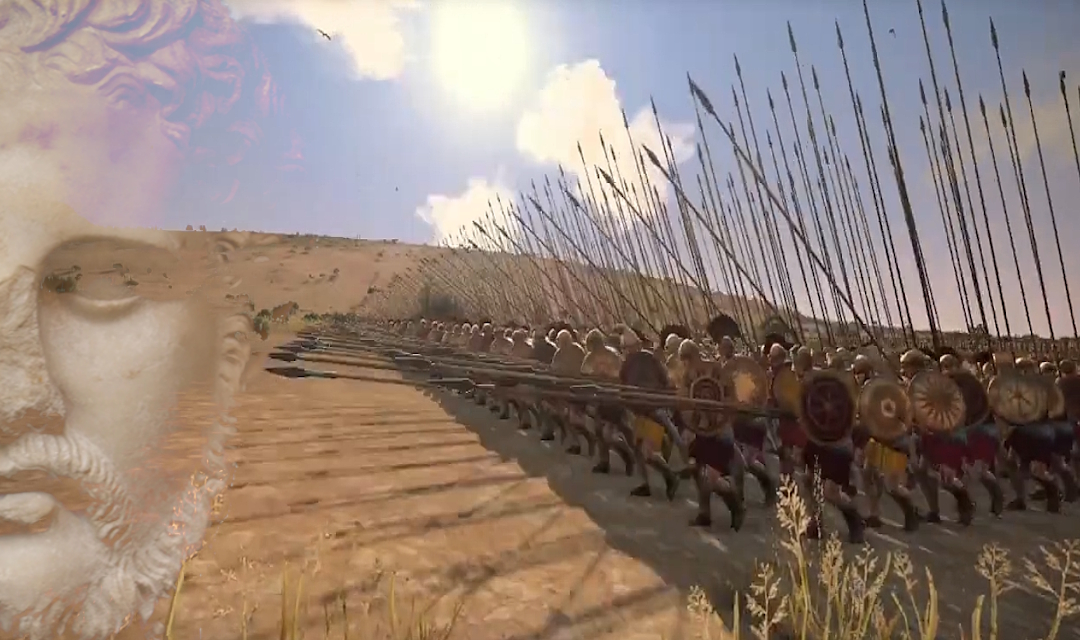
Philip’s most famous tactical innovation was the reimagined Macedonian phalanx, composed of the pezhetairoi (Foot Companions). He stripped them of the heavy, expensive bronze breastplates and large shields used by traditional Greek hoplites. Instead, they wore lighter armor and carried a smaller shield (pelte) strapped to the left shoulder.This reduction in defensive armor was offset by a terrifying offensive upgrade: the sarissa.The sarissa was a massive pikeshaft made of tough cornel wood, stretching between 4.5 and 6 meters (15 to 18 feet) in length. It featured a heavy iron point at the front and a bronze butt-spike at the rear for balance and anchoring into the ground.When deployed in a dense formation, the first five ranks of the phalanx projected their long pikes forward, creating an impenetrable wall of steel. Traditional Greek hoplites, armed with spears only half that length, were impaled long before they could get within striking distance. The remaining rear ranks held their pikes upright or at an angle, creating a canopy that deflected incoming enemy arrows and javelins.
3. The Shock Cavalry: The Companion Hammer
While the infantry held the line, Philip looked to Macedon’s traditional strength—its nobility—to deliver the decisive blow. He reorganized the aristocratic horsemen into the Hetairoi (Companion Cavalry), establishing them as antiquity’s premier shock force.Philip introduced two key adaptations that unlocked the cavalry’s true potential:The Wedge Formation: Borrowed from the Thracians and Scythians, Philip trained his cavalry squadrons to ride in a triangular wedge. The commander rode at the very tip, directing the charge. This shape allowed the squadron to change direction rapidly and focus its entire momentum onto a single, narrow point in the enemy line, piercing it like a knife.The Xyston: Riders were armed with the xyston, a 2.7-meter (9-foot) cornel-wood lance used for thrusting rather than throwing. This weapon allowed them to outreach enemy cavalry and strike infantrymen from horseback with tremendous force.
4. The Invention of Combined Arms
Philip’s true genius lay not just in inventing these individual components, but in combining them into a synchronized tactical system. This approach is famously known as the “Hammer and Anvil” strategy.
In this system, each unit had a distinct, interdependent role:
- The Anvil (The Phalanx): The slow, massive wall of pikes marched forward to pin the main enemy army in place. The enemy could not retreat, and they could not break through the wall of sarissas.
- The Shield (The Hypaspists): Because the phalanx was vulnerable on its flanks, Philip created the hypaspists (Shield-Bearers). These elite, agile light-infantrymen acted as a tactical hinge, keeping pace with the fast cavalry while protecting the exposed sides of the infantry.
- The Hammer (The Companions): Once the enemy was pinned by the phalanx and a gap opened in their lines, Philip or Alexander would lead the Companion Cavalry in a devastating wedge charge directly into the enemy’s flank or rear.
5. Tearing Down the Walls: The Siege Train
Before Philip II, siege warfare in the Greek world was primitive. It primarily relied on passive starvation, as Greek city-states lacked the engineering capabilities to breach stone walls. Philip changed the rules of geography by establishing the Gastraphetes (a massive belly-bow) and hiring the finest engineers of the Mediterranean, notably Polyidus of Thessaly.
Philip’s engineering corps introduced the torsion catapult, which utilized tightly twisted bundles of animal sinew and human hair to store mechanical energy. This allowed machines to hurl massive stones and heavy bolts with immense velocity, systematically obliterating city battlements.
Furthermore, Philip developed mobile, iron-plated siege towers (helepoleis) and covered battering rams to protect his men during assaults. By removing the safety of city walls, Philip ensured that no enemy could hide from his professional army, transforming the geopolitical landscape of the Aegean.
6. The Ultimate Litmus Test: The Battle of Chaeronea (338 BCE)
The true capabilities of Philip’s cumulative system were demonstrated at the Battle of Chaeronea, where Macedonia faced the combined armies of Athens and Thebes—the traditional superpowers of Greece.
Philip deployed his phalanx on the right wing and ordered a deliberate, slow retreat. The overconfident Athenian hoplites, believing they had the Macedonians on the run, broke their dense formation to pursue them. This reckless advance pulled the Allied Greek line apart, creating a fatal gap between the Athenians and the elite Theban Sacred Band on the opposite flank.
Watching from the Macedonian left, an 18-year-old Alexander saw the opening. Leading the Companion Cavalry in a razor-sharp wedge formation, Alexander shattered through the gap and encircled the Thebans from behind. Simultaneously, Philip ordered his phalanx to halt their feigned retreat and charge forward. Caught between the anvil of Philip’s pikes and the hammer of Alexander’s horsemen, the Greek alliance was utterly crushed, securing Macedonian hegemony over Greece.
7. The Blueprint for Global Conquest
When Philip was assassinated in 336 BCE, he left behind a highly tuned, perfectly balanced engine of war. When Alexander inherited the crown, he did not change the core mechanics of his father’s army; instead, he specialized and diversified it to survive the vast, unpredictable landscapes of the Persian Empire.
To defeat a superpower that utilized massive armies, chariot warfare, and elite missile troops, Alexander modified Philip’s system in four critical ways:
1. Integration of Foreign Skirmishers
Philip’s army was built for the open plains of Greece. Alexander realized that to survive the rugged terrain of Asia, he needed elite, specialized light infantry to protect his heavy units.
- The Agrianians: Alexander relied heavily on these elite javelin-throwers from Thrace. They were highly mobile mountain troops used to scale cliffs, flush out ambushes, and hunt down Persian chariot teams before they could reach the Macedonian lines.
- Cretan Archers: He increased the role of these archers to counter the lethal range of Persian bowmen, providing a vital missile screen for the phalanx.
2. Adaptation to Persian Cavalry Tactics
Persian cavalry was excellent, highly numerous, and frequently attempted to encircle Alexander’s smaller army. To counter this at battles like Gaugamela, Alexander modified his tactical deployment:
- The Defensive Flank Screen: He placed diagnostic lines of light cavalry (like the Prodromoi or scouts) and allied Thessalian horsemen at an angle to his main line. This created a flexible, refused flank that absorbed the Persian enveloping maneuvers, keeping his core units safe.
- The Secondary Line: Alexander introduced a second line of infantry behind his main phalanx. If the Persians managed to ride around his flanks, this second line could simply face backward, transforming the army into an un-encircleable, hollow defensive square.
3. Lightening the Phalanx for Speed
As the campaign pushed deeper into the mountainous regions of Bactria and Sogdiana (modern Afghanistan), the heavy, rigid 18-foot sarissa phalanx became a liability against swift guerrilla fighters.Alexander frequently stripped his phalangites of their heavy pikes, re-arming them with shorter spears and javelins.
He relied more heavily on the hypaspists (agile shield-bearers) to conduct rapid night-marches and mountain assaults where the traditional phalanx could not form up.
4. Creation of the Asian Cavalry Units
As the war progressed, Macedonian manpower began to dwindle from casualties and garrison duties. Alexander solved this by breaking traditional ethnic barriers and incorporating conquered peoples into the elite core of his army.He drafted Persian, Bactrian, and Sogdian horsemen into the military.
Crucially, he integrated elite Persian noble youths directly into the Hetairoi (Companion Cavalry) and created new units of horse-archers, adopting the very eastern tactics that had previously troubled his forces.