Ancient Roman buildings have endured for millennia because they were conceived with a fundamentally different philosophy of construction—one rooted in permanence, resilience, and adaptation to natural forces. Roman engineers did not simply build structures; they engineered systems that could interact with their environment over time. They understood, even without modern scientific language, that materials behave dynamically under stress, temperature changes, and moisture. This long-term thinking meant that their buildings were not optimized for short-term efficiency, but for structural stability across centuries, even under unpredictable conditions.
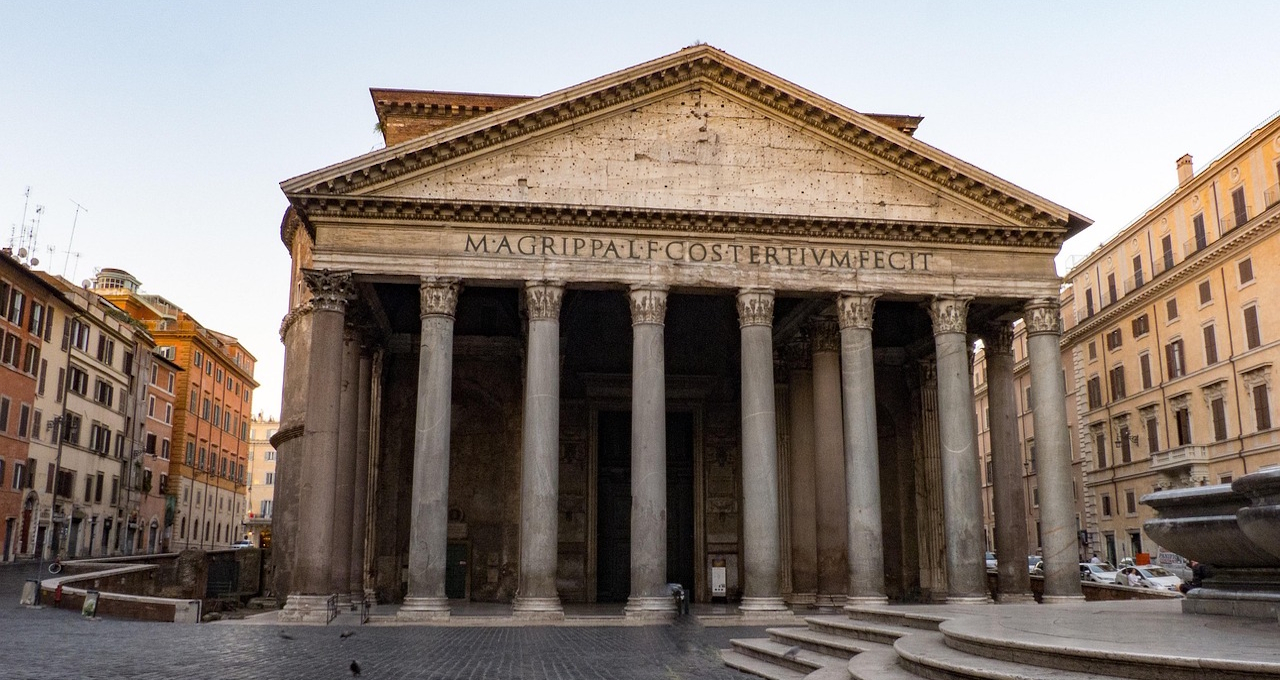
At the heart of this durability lies Roman concrete, known as opus caementicium, whose composition differs significantly from modern Portland cement. Instead of relying heavily on finely ground clinker, Roman concrete combined lime (calcium oxide), water, and volcanic ash known as pozzolana. This ash, rich in silica and alumina, reacted chemically with lime in a process similar to a pozzolanic reaction, forming strong calcium-aluminum-silicate-hydrate (C-A-S-H) compounds. These crystalline structures created a dense, interlocking matrix that gave the material both strength and resistance to cracking. Monuments like the Pantheon remain standing because this internal microstructure continues to stabilize and reinforce itself over time.
Even more remarkable is the self-healing capability of Roman concrete, which modern materials science has only recently begun to fully understand. During the mixing process, small chunks of unreacted lime—called lime clasts—remained embedded within the structure. When microcracks formed and water penetrated them, these lime clasts reacted with the water to produce calcium hydroxide, which then crystallized into calcium carbonate (calcite). This mineral growth effectively sealed the cracks from within, preventing further propagation. In marine environments, interactions with seawater even led to the formation of rare minerals like aluminous tobermorite, which further strengthened the structure rather than degrading it.
Structural design also played a critical scientific role in the longevity of Roman buildings. The widespread use of arches, vaults, and domes reflects an advanced understanding of load distribution and compressive forces. Unlike flat beams, which experience bending stress, arches convert vertical loads into compressive forces that travel along curved paths into the supports. This minimizes tensile stress, which materials like stone and concrete are less capable of handling. The dome of the Pantheon is a prime example: its thickness gradually decreases toward the top, reducing weight while maintaining structural integrity, and its coffered ceiling reduces mass without compromising strength.
Roman construction methods further enhanced durability through redundancy and overengineering. Walls were often built in layers, with a concrete core faced by brick or stone, creating a composite system that combined strength with environmental resistance. Foundations were carefully adapted to soil conditions, sometimes incorporating deep pilings or compacted gravel layers to prevent shifting. From a scientific perspective, this reflects an intuitive grasp of load-bearing capacity, soil mechanics, and material fatigue. By distributing stress across large volumes and avoiding weak points, Roman builders reduced the likelihood of catastrophic failure.
Finally, the longevity of Roman structures is also tied to environmental interaction and continued human use. Many buildings survived because they were maintained, repaired, and repurposed over centuries, preventing the kind of neglect that accelerates material decay. At the same time, the chemical stability of Roman concrete made it highly resistant to processes like corrosion, freeze-thaw cycles, and salt crystallization. In essence, Roman buildings endure because they combine favorable chemistry, intelligent structural physics, and adaptive use over time. Their survival is not accidental—it is the result of a sophisticated, almost systems-level understanding of how materials and forces behave across centuries.