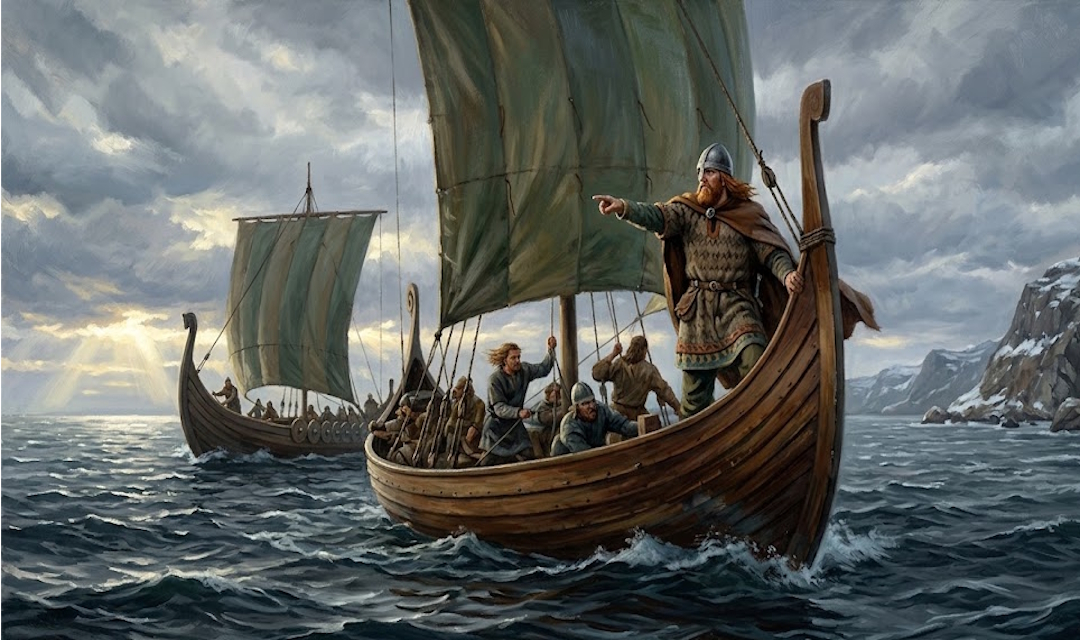
Around the year 1000 CE, the Norse settlers of Greenland, themselves descendants of intrepid explorers from Iceland, were inspired by tales of distant, fertile lands to the west. Stories passed down by traders and early explorers like Bjarni Herjólfsson described shores lush with forests, rivers, and wildlife, beyond the known world. Leif Erikson, son of Erik the Red, became determined to explore these uncharted territories. Gathering a small fleet of longships, he prepared to cross the Atlantic with the aim of scouting potential settlements, seeking resources, and expanding Norse knowledge of distant lands. This expedition was motivated not just by curiosity, but by survival, opportunity, and the allure of fame in Norse society, where discovery and daring voyages earned lasting prestige.
Crossing the Atlantic: Navigating Dangerous Seas
The journey from Greenland to Vinland was a feat of both skill and courage. The North Atlantic is notoriously unpredictable, with strong currents, sudden storms, icebergs, and dense fog. The Norse navigators relied on a combination of tools and experience: sunstones, which could locate the sun through overcast skies, careful observation of the sun’s position, stars, ocean currents, and even the flight patterns of seabirds to determine proximity to land. The longships themselves were engineering marvels, long and narrow with a shallow draft, allowing them to ride waves efficiently and navigate shallow waters. Rowers provided propulsion during calm winds, while a square sail allowed speed when favorable winds prevailed. Each crossing required constant vigilance, seamanship, and a deep understanding of the ocean’s moods.
First Landfall: Helluland and Markland
The first landfall of the Norse fleet was in Helluland, likely modern-day Baffin Island. The sagas describe a rocky, barren coastline with little timber or arable land but abundant stone resources and small wildlife. While not suitable for settlement, Helluland served as an important navigational waypoint. Continuing southward, the fleet reached Markland, probably Labrador, a densely forested area rich in timber. This allowed the Norse to gather resources essential for ship repair and construction. Markland also offered hunting grounds for caribou and other game, providing sustenance. These early landings allowed the explorers to acclimate to new landscapes and build the confidence needed to press further toward the promising lands of Vinland.
Vinland: Promise of Settlement
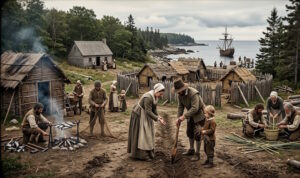
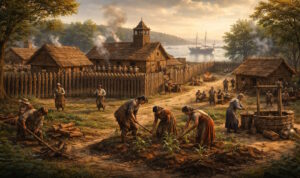
Upon reaching Vinland, the Norse found a land remarkably different from Greenland’s harsh environment. According to the sagas, Vinland offered rivers teeming with fish, forests filled with game, and wild grapes suggesting a temperate climate. Archaeological evidence at L’Anse aux Meadows confirms Norse occupation, showing turf-covered longhouses, workshops for metalwork and carpentry, and storage pits for provisions. The Norse attempted to establish a small settlement capable of sustaining them for months, possibly years, while exploring and assessing the land. The location’s coastal rivers and inlets provided excellent anchorage for their longships, while the surrounding forests offered wood for construction and fuel.
Meeting the Skrælingjar
The Norse soon encountered the indigenous peoples, whom they called Skrælingjar. These groups were likely ancestors of the Beothuk or other First Nations peoples of Newfoundland and Labrador. Initial contact may have involved cautious observation, tentative exchanges of food, furs, or tools, and a mutual curiosity about foreign technology and culture. The Vikings noted the Skrælingjar’s adept use of bows and arrows, intimate knowledge of local wildlife, and mobility across forests and waterways. Similarly, the Skrælingjar would have observed the unusual appearance of the Norse longships, iron tools, and weaponry. Early interactions were characterized by curiosity, diplomacy, and a delicate balance of mutual caution.
Tensions Arise
Despite early exchanges, tensions quickly developed due to competing needs and misunderstandings. The Vikings sought land for grazing livestock and timber extraction, which interfered with indigenous hunting grounds and seasonal migrations. Miscommunication, cultural differences, and contrasting expectations about land use and trade exacerbated conflict. Even minor incidents, such as the loss of a traded item or a perceived insult, could escalate rapidly. These tensions highlight the challenges of first contact: two societies with different survival strategies, social norms, and worldviews clashing over shared space and resources.
The First Clashes
Eventually, these tensions erupted into open conflict. The sagas describe skirmishes involving arrows, spears, and close combat, with Norse longhouses sometimes attacked or set ablaze. The Skrælingjar leveraged their deep knowledge of the terrain, using forest cover and waterways for guerrilla-style tactics, while the Vikings relied on their metal weapons and shields. Despite the technological advantage of iron, the Norse were heavily outnumbered and unfamiliar with the dense, forested environment. Battles were chaotic and exhausting, with strategic withdrawals necessary to avoid catastrophic losses. At least one significant confrontation forced the Vikings to retreat, revealing the vulnerability of even well-armed explorers in unknown territory.
Life Under Threat
Even as skirmishes threatened the settlement, the Norse attempted to maintain daily routines. They hunted caribou, fished rivers, gathered berries, and explored inland areas to understand the land’s resources. Craftsmen repaired ships, forged tools, and maintained longhouses. However, constant vigilance against attack, homesickness, and uncertainty about reinforcements from Greenland weighed heavily on morale. Life in Vinland required both resilience and ingenuity; settlers had to balance survival, exploration, and defense in an alien environment.
Logistical Challenges Supporting a settlement in Vinland was fraught with difficulty. Greenland’s small population could not spare enough settlers, livestock, or resources for a large-scale colonization. Voyages across the Atlantic were long and dangerous, and transporting provisions, timber, and animals risked heavy losses from storms, ice, and unpredictable currents. Maintaining a steady supply line was nearly impossible, especially if the Skrælingjar resisted or sabotaged efforts. These logistical constraints made the idea of returning with hundreds of settlers impractical, leaving the Norse limited to small, temporary expeditions.
Decision to Withdraw
Faced with hostile encounters, environmental hardships, and logistical difficulties, the Norse abandoned Vinland after only a few years. Archaeological evidence at L’Anse aux Meadows shows no signs of permanent occupation, confirming the settlement was temporary. The indigenous populations retained control of the land, continuing their traditional way of life uninterrupted. For the Vikings, the withdrawal was a pragmatic decision: survival, resource management, and the risk of further losses outweighed the benefits of colonization.
The Return That Almost Happened
After the withdrawal from Vinland, the story did not simply vanish—it lingered. In the settlements of Greenland and Iceland, sailors and survivors spoke of fertile lands, rich forests, and dangerous encounters. Some chieftains argued that the failure was not due to the land itself, but to the small size of the expedition. Around the fires, a new idea formed: what if they returned not as explorers—but as a force strong enough to hold the land? Plans may have been whispered, debated, even partially prepared. But hesitation always followed. Too many risks. Too few people. And the memory of resistance that could not be easily crushed.
The Silent Trade Route
Even after abandoning settlement, the Norse may not have completely abandoned Vinland. Some historians suggest that sporadic voyages continued, especially to Markland, where timber was abundant. Greenland lacked large trees, making wood extremely valuable. It is possible that small crews returned quietly, avoiding conflict, cutting timber, and leaving before tensions could rise.
What If They Had Stayed Longer?
If the Norse had managed to endure for decades, the outcome might have changed dramatically. Children would have grown up in Vinland, adapting to the environment. Knowledge of the land would improve. Trade with indigenous groups might have stabilized—or conflict might have escalated into something larger. Over generations, a new hybrid culture could have emerged, blending Norse and indigenous elements. Language, tools, and survival strategies might have merged into something entirely unique.