
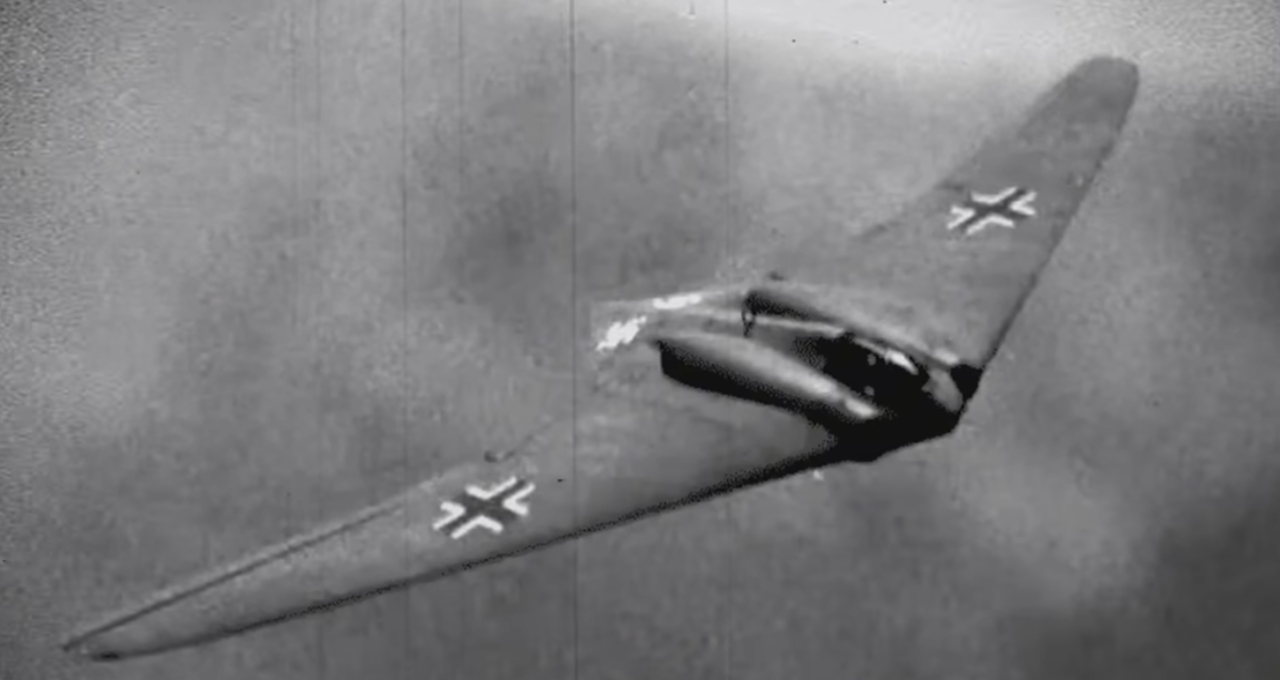
The Horten Ho 229 (often designated Gotha Go 229) is arguably the most enigmatic aircraft of World War II. It represents a collision between radical aerodynamic theory and the desperate “Wonder Weapon” (Wunderwaffen) programs of a collapsing Third Reich.
The Philosophical Origins of the Wing
The Ho 229 was the culmination of a lifelong obsession for Walter and Reimar Horten, two brothers who viewed the traditional airplane as an aerodynamic failure. Starting in the early 1930s as teenagers in the Bonn glider club, they experimented with “all-wing” designs, believing that every square inch of an aircraft should contribute to lift. While contemporary designers were adding bigger engines to overcome the drag of fuselages and tail fins, the Hortens were mathematically proving that a “pure” wing could achieve the same speeds with half the thrust. Their early gliders, the H I through H IV, were the laboratory for what would eventually become the world’s first jet-powered flying wing. Reimar Horten once famously stated that a tail was merely “an insurance policy paid for in drag,” and he spent his life trying to cancel that policy.
The “3 x 1000” Dictate and Survival
By 1943, the German Luftwaffe was in a death spiral, facing the combined industrial might of the Allies. Reichsmarschall Hermann Göring issued his famous “3 x 1000” mandate, a desperate call for a bomber that could carry a 1,000 kg bomb load, travel at 1,000 km/h, and reach a distance of 1,000 km. Most German manufacturers deemed this impossible with the primitive, fuel-gulping Junkers Jumo 004 jet engines of the time, which had a specific fuel consumption so high they could barely stay aloft for an hour. However, the Horten brothers calculated that the extreme efficiency of their “Nurflügel” (only wing) design—which lacked the parasitic drag of a fuselage—was the only way to meet these specs. They circumvented official channels, using Walter’s status as a decorated Bf 109 pilot to gain a private audience with Göring, eventually securing 500,000 Reichmarks to begin Projekt IX.
Radical Materials and Wartime Scarcity
Because high-grade aluminum and chromium were being diverted to Me 262 production, the Ho 229 had to be built from “non-strategic” materials. The center section was a complex web of welded steel tubing, but the massive 55-foot wings were constructed almost entirely of furniture-grade plywood. These wings were composed of two thin skins of plywood bonded with a urea-formaldehyde resin, sandwiching a core of sawdust and charcoal. This “composite” approach was born of necessity but resulted in an incredibly smooth surface that reduced parasitic skin-friction drag to near-zero levels. To protect the wooden trailing edge from the 600°C inferno of the jet exhaust, the Hortens used thin steel plating. An interesting side story involves the “charcoal” layer; while often cited as a stealth component, factory workers noted it was primarily used as a cheap filler to thicken the glue and fill gaps in the hurried wartime assembly.
Technical Data and Performance Metrics
The projected performance of the Ho 229 V3 was staggering for its era. It featured a wingspan of 16.76 meters and a wing area of 50.2 square meters, providing immense lift even at low speeds. Its maximum speed was estimated at 977 km/h (607 mph) at high altitude, which would have made it faster than almost any Allied fighter in existence. The aircraft was powered by two Junkers Jumo 004B turbojets, buried deep within the wing root to maintain the clean aerodynamic profile.
Its service ceiling was a breath-taking 16,000 meters, an altitude where it would be virtually immune to anti-aircraft fire and most interceptors. Furthermore, it was designed to pull up to 7g, making it structurally sturdier than many metal-skinned fighters of the period.
The Nightmare of Tail-less Flight Control
One of the greatest technical hurdles was ensuring the plane didn’t spin out of control without a vertical rudder. To solve the yaw problem, the Hortens used a sophisticated system of “drag rudders” or spoilers. When the pilot pushed a rudder pedal, a small picket-fence-like spoiler would pop out of the wingtip, creating intentional drag to swing the nose in that direction. For pitch and roll, they used “elevons”—moveable surfaces that combined the functions of elevators and ailerons. Because the plane was “inherently unstable” on the yaw axis (tending to “hunt” or wiggle left and right), flying it required a pilot with immense skill. A forgotten detail is that the Hortens actually designed a “bell-shaped lift distribution” which naturally reduced the tendency to yaw, a mathematical breakthrough that NASA would later study for Mars gliders.
The First Jet Flights: A Brief Triumph
The powered testing phase began in early 1945 at Oranienburg. The H.IX V2 prototype took to the skies on February 2, 1945, with test pilot Erwin Ziller at the controls. Early reports were glowing; the aircraft was said to be surprisingly stable in a straight line and possessed a turn radius that left the Me 262 in its wake. During these mock trials, Ziller noted that the aircraft’s lack of a fuselage gave him an incredible field of vision—he could see almost directly behind him through the glass canopy. However, the jet engines were notoriously unreliable, often flaming out or catching fire. The V2 was equipped with a heavy-duty tricycle landing gear—the nose wheel of which was scavenged from a crashed Heinkel He 177—to handle the high-speed landings required by the wing’s low-drag profile.
The Fatal Crash of February 18, 1945
The promise of the Ho 229 was cut short during its third test flight. While approaching for a landing, one of Ziller’s Jumo engines suffered a total mechanical failure. In a desperate bid to save the secret prototype, Ziller refused to bail out, attempting to restart the engine by diving and pulling up to “windmill” the turbines. Witnesses saw the aircraft perform several erratic turns before it plummeted into a field just short of the runway. Ziller was thrown from the cockpit and died shortly after. It is widely speculated by modern aviation historians that toxic fumes from a fuel leak or a hydraulic fire had knocked Ziller unconscious before the impact, as he made no attempt to use his radio or deploy his parachute during the final moments of the descent.
Stealth: The “Inadvertent” Pioneer
The Ho 229 is frequently called the “grandfather of stealth.” When Northrop Grumman built a full-scale replica for radar testing in 2008, they found that against the 1940s British “Chain Home” radar, the Ho 229’s radar cross-section (RCS) was significantly lower than a standard fighter. Its smooth, sloping shape naturally deflected radar waves away from the receiver. However, the Smithsonian’s chemical analysis of the original V3 airframe found that while there were carbon particles in the glue, there was no evidence of a deliberate, sophisticated radar-absorbent material (RAM). A curious detail is that the Hortens were more worried about “visual stealth”—painting the aircraft in a mottled grey and green to blend into the cloudy European skies rather than trying to hide from the then-primitive radar.
High-Altitude Survival and the Dräger Suit
Because the Ho 229 was designed to operate at the edge of the stratosphere, the pilot faced the very real threat of hypoxia and “blood boil” if the cockpit pressurized seal failed. To combat this, the German firm Dräger designed a specialized pressure suit that looked like a proto-astronaut outfit. The cockpit itself was a tight, cramped space located directly between the two roaring jet engines, leading to immense heat and noise vibration. To assist with the pilot’s survival during a high-speed emergency, the V3 was fitted with one of the world’s first ejection seats, a catapult-based system designed to clear the pilot over the massive trailing edge of the wing. Interestingly, the pilot sat in a reclined position to help handle high G-forces, a feature not common in jets until the F-16 decades later.
The Mystery of the “Missing” V3 Parts
When the U.S. 8th Armored Division captured the Gotha factory in April 1945, they found the V3 prototype nearly complete, but several key components were missing. The specialized MK 108 30mm cannons and the advanced Revi 16B gunsight had not yet been installed. More mysteriously, many of the technical blueprints and calculation sheets were burned by the retreating Germans or hidden by Reimar Horten. One story suggests that Reimar hid a set of microfilm blueprints in a hollowed-out log in the woods, though they were never recovered. This gap in the historical record fueled decades of rumors that the Hortens had developed even more advanced versions, including a trans-Atlantic “Amerikabomber” variant (the H.XVIII), which existed only as a set of ambitious sketches and wind-tunnel models before the war’s end.
Captured and Transported: Operation Paperclip
The V3 prototype was recognized by American intelligence as a prize of immense value. Under the secret Operation Paperclip, the airframe was crated up and shipped across the Atlantic to the Silver Hill facility in Maryland. It was evaluated by U.S. Air Force engineers, who were simultaneously impressed by its aerodynamics and horrified by its “shoddy” wooden construction—some parts were held together with wood screws that had been stripped. For years, it sat in a state of decay, exposed to the elements in open-air storage, which caused the plywood to delaminate and rot. It wasn’t until the 1990s that the Smithsonian moved it indoors, recognizing that this fragile wooden “bat” was one of the most significant artifacts in the history of flight.
Conservation in the 21st Century
As of 2026, the Ho 229 V3 is undergoing a meticulous conservation process at the Steven F. Udvar-Hazy Center. Unlike a standard restoration, the goal is not to make it look “new,” but to preserve the original 1945 materials. Conservators use chemical stabilizers to prevent the urea-formaldehyde glue from turning to dust and treat the wood for fungal infections that have persisted for eight decades. The center section, with its exposed steel ribs and rusting Jumo engines, is on public display. A fascinating find during the 2020s was the discovery of original pencil marks on the inner wing spars, likely left by a factory worker 80 years ago, highlighting the human element in this “alien” machine.
A Magnet for Revisionist Speculation
The Ho 229 occupies a space in history more akin to a UFO than a standard military aircraft. This visual shock has made it fertile ground for “Wunderwaffe” (Wonder Weapon) myths, where enthusiasts claim that if the plane had been deployed six months earlier, it would have single-handedly won the war. These theories often ignore the logistical reality: Germany lacked the fuel, the trained pilots, and the engine longevity (the Jumo 004 lasted only 25 hours) to field a wing of Ho 229s effectively. One popular story is that the Horten was intended to be a “kamikaze” aircraft for hitting New York, but there is zero evidence the brothers ever intended their masterpiece to be a one-way weapon.
The Argentine Exile and Modern Legacy
After the war, Reimar fled to Argentina in 1948. He continued to design wings, including the I.Ae. 37 Jet, a supersonic flying wing where the pilot lay in a prone position to handle high G-forces. Reimar lived on a ranch, secretly corresponding with NASA and Northrop engineers about his “Bell-Shaped” theories. While the Northrop B-2 Spirit was not a direct copy of the Ho 229, it stands as the spiritual successor to the brothers’ dream. Today, the Ho 229 remains a magnet for revisionist speculation—a haunting, skeletal reminder of a technological leap that occurred just as the regime that birthed it was collapsing into the history books.
The “Video Game” Resurrection
Perhaps no other factor has contributed to the Ho 229’s legendary status more than its appearance in modern digital media. In games like War Thunder, the Ho 229 is portrayed as a dominant, high-speed predator, often granted performance capabilities it never actually achieved in its brief, tragic test flights. This “digital afterlife” has blurred the lines between the historical V3 prototype—a fragile, unfinished, and somewhat unstable wooden testbed—and the mythical “Go 229″—an invincible stealth jet. Consequently, more people today know the aircraft from flight simulators than from historical archives.
Controversy: Fact vs. Fiction
The Ho 229 is frequently called the “World’s First Stealth Fighter.” In 2008, Northrop Grumman (builders of the B-2 Spirit) built a full-scale replica to test its radar cross-section (RCS).
The Findings: Against the British “Chain Home” radar of 1945, the Ho 229 would have been detected roughly 20% later than a standard fighter. This would have cut detection time from 19 minutes to about 8 minutes—potentially enough to outrun interceptors.
The “Charcoal Glue” Myth: Reimar Horten claimed in the 1980s that he mixed charcoal into the glue to absorb radar. Modern Smithsonian analysis found no evidence of this. While black particles were found in the glue, they are likely carbon-based soot or sawdust used as a filler, common in wartime manufacturing, rather than a deliberate “stealth coating.”
Another misconception is that the aircraft’s development was driven by advanced stealth doctrine. In reality, it was part of Germany’s broader effort to build faster jet-powered aircraft late in the war. The Ho 229 V2 prototype was tested, but its development was never completed due to the collapse of Nazi Germany in 1945. Because of this, the project never reached the stage where extensive operational evaluation or refinement could validate many of the later claims made about it.
One of the most persistent legends is that the Ho 229 was designed to be “silent.” This is a misunderstanding of its aerodynamics. Because it lacked a tail and fuselage, it had a very small “frontal area,” meaning that to an observer on the ground, the plane would be visually and audibly “delayed.” By the time you heard the roar of the Jumo engines, the plane—traveling at nearly 600 mph—would have already passed overhead. This “acoustic stealth” wasn’t a deliberate technology but a byproduct of its extreme speed and sleek profile, contributing to the “ghost” stories told by those who imagined it in combat.