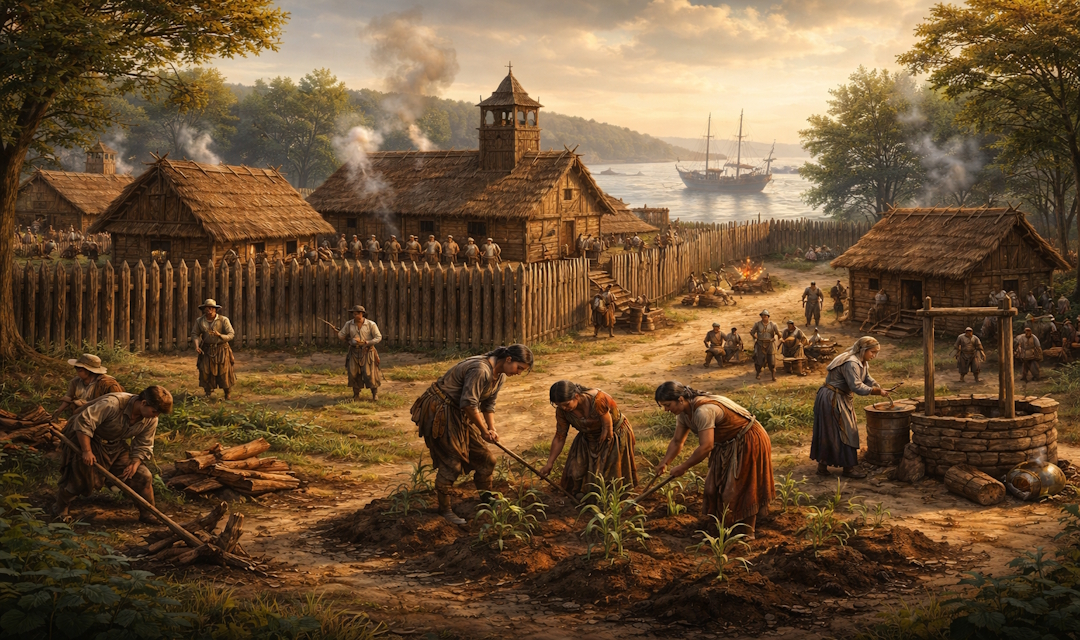
The colonization of North America was not a singular event of conquest, but a grueling, multi-decade process defined by trial, error, adaptation, and survival under extreme conditions. While popular narratives often emphasize imperial ambition and famous historical figures, the reality of early English settlement—especially the founding of Jamestown, Virginia in 1607—reveals a far more complex story. It was a story shaped by environmental hardship, fragile diplomacy with Indigenous nations, internal social conflict, and gradual institutional transformation.
By the late 16th and early 17th centuries, England was entering a period of overseas expansion later than its Iberian rivals. Spain and Portugal had already established profitable colonial systems fueled by precious metals and global trade networks. In contrast, England sought to replicate and compete with these successes, driven by economic pressures at home, population growth, and the desire for new markets and resources. However, rather than being funded directly by the Crown, early English colonization efforts were largely organized through private investment models, particularly the chartered Virginia Company of London, an organization that operated Jamestown as a joint-stock venture.
Founding Jamestown and Early Strategic Considerations
The founding of Jamestown, Virginia in 1607 marked the beginning of the first permanent English settlement in North America, but it was not the result of careful long-term planning. Instead, it emerged from a mixture of ambition, urgency, and limited understanding of the environment. Organized by the Virginia Company of London, the expedition set sail in December 1606 aboard three ships—the Susan Constant, Godspeed, and Discovery. The settlers were tasked not only with establishing a foothold in the New World but also with generating profit through the discovery of resources such as gold or new trade routes.
After a long and difficult voyage, the expedition reached the Chesapeake Bay in May 1607 and moved inland along the James River. The choice of location for Jamestown was primarily strategic rather than practical. The settlers deliberately selected a site about 40 miles inland to reduce the risk of attack from Spanish naval forces, which were a major concern at the time. The deep-water anchorage allowed ships to dock close to shore, ensuring easier resupply and defense. In addition, the peninsula location meant that the settlement could be more easily fortified, with water on three sides and a narrow land connection.
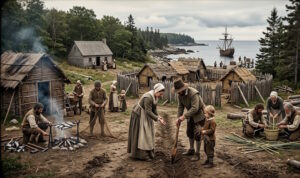
To secure their position, the settlers quickly constructed a triangular fort surrounded by wooden palisades. This design was efficient, requiring fewer materials than a square fort while still providing strong defensive coverage. Each corner featured a bastion where cannons could be placed, allowing defenders to cover all approaches. Inside the fort, essential buildings were erected, including a church, storehouse, and basic shelters. The layout reflected immediate military concerns rather than comfort or long-term development, reinforcing the idea that Jamestown began as a defensive outpost rather than a planned community.
However, the strategic advantages of the site came at a significant cost. The land was marshy and poorly suited for agriculture, and the surrounding environment was unfamiliar to the settlers. Fresh drinking water was difficult to obtain, as the nearby river was often brackish and contaminated. The swampy conditions also created an ideal breeding ground for mosquitoes, which contributed to the spread of diseases such as malaria. These environmental factors quickly undermined the initial benefits of the location and became major obstacles to survival.
In the end, the founding of Jamestown highlights a critical tension between military strategy and environmental reality. The settlers chose a site that could be defended, but not one that could easily sustain life. This decision shaped the colony’s early struggles, forcing its inhabitants to adapt rapidly or face extinction. Jamestown’s survival would ultimately depend not on its strategic position alone, but on its ability to overcome the challenges created by that very choice.
Relations with Native Americans and Early Survival
Relations between the English settlers of Jamestown and the local Native American populations were central to the colony’s survival in its earliest years. These interactions were complex, shifting between cooperation, trade, diplomacy, tension, and open conflict. The most important Indigenous political entity in the region was the Powhatan Confederacy, a powerful alliance of Algonquian-speaking tribes led by Chief Powhatan.
From the beginning, the settlers depended heavily on Native Americans for survival. The English arrived with limited knowledge of local agriculture, climate, and resources, and their initial attempts at farming were poorly suited to the environment. Indigenous communities, by contrast, had developed sophisticated agricultural systems based on crops such as maize (corn), beans, and squash, often referred to as the “Three Sisters.” Through trade, the Powhatan Confederacy supplied the colonists with vital foodstuffs during periods of scarcity. Corn, in particular, became a lifeline during the colony’s most desperate years.
However, relations were never purely cooperative. The Powhatan leadership viewed the English settlement as both a potential trade partner and a strategic threat. In some cases, Native Americans provided food in exchange for tools, metal goods, and other European items. In other instances, tensions arose due to competition over land and resources. The English increasingly sought to expand their footprint, clearing land for agriculture and fortifications, which disrupted local hunting grounds and traditional territories.
Diplomacy played an important role in early interactions. Figures such as Pocahontas became symbolic intermediaries between the two groups, helping to facilitate communication and temporary peace. Her association with the colony—whether viewed through historical accounts or later interpretations—reflects the broader attempts at alliance-building between the English and the Powhatan Confederacy. Periods of relative stability were often maintained through such diplomatic ties, allowing trade and limited cooperation to continue.
Despite these efforts, relations deteriorated over time as the English colony grew stronger and more self-sufficient. Competition for land intensified, and mutual distrust increased. Conflicts eventually escalated into violence, marking a transition from early interdependence to open hostilities. These tensions would shape the long-term trajectory of the colony and its expansion, setting the stage for broader patterns of displacement and conflict between European settlers and Native American societies across the region.
In summary, the relationship between Jamestown’s settlers and Native Americans was foundational to the colony’s early survival. Without Indigenous assistance, particularly in food supply and local knowledge, the colony might not have endured its initial hardships. At the same time, differences in cultural priorities, land use, and political objectives created enduring friction that evolved from cooperation into conflict as colonial ambitions expanded.
Agriculture in Jamestown, Virginia began under conditions of uncertainty and failure.
When the settlers arrived in 1607, they brought with them English farming traditions that were poorly suited to the Chesapeake environment. They attempted to grow familiar crops such as wheat and barley using European techniques like broadcast sowing, but they lacked the knowledge needed to clear dense forests effectively or adapt to the region’s soil and climate. Even more critically, many colonists were not farmers at all, but gentlemen and adventurers who prioritized the search for gold over food production. This early miscalculation left the colony dangerously unprepared.
In these first months, survival depended heavily on the Powhatan Confederacy. The Powhatan people supplied the English with maize, fish, and other food sources, effectively sustaining the colony when its own efforts failed. They also introduced the settlers to local crops and demonstrated basic agricultural practices suited to the land. However, these exchanges were not guaranteed or purely cooperative; they were shaped by political considerations and fluctuating trust. As English demands increased, tensions grew, making reliance on Indigenous support increasingly unstable.
By 1608 and 1609, the colonists began to adopt Indigenous farming methods, though often slowly and imperfectly. Maize became the central food crop, planted using mound-based techniques that improved drainage and root development. Beans and squash were also cultivated, reflecting elements of the “Three Sisters” system, which helped maintain soil fertility and maximize yield. Despite these improvements, environmental challenges—particularly a severe drought—combined with poor organization led to weak harvests. The colony remained vulnerable, and agricultural instability contributed directly to the crisis that followed.
The winter of 1609–1610, known as the “Starving Time,” marked the collapse of early agricultural efforts. Crop failures, disrupted trade, and a breakdown in leadership left the settlers with almost no food. Farming activities ceased almost entirely as survival became the only priority. This period exposed the fragility of the colony’s food systems and underscored the consequences of failing to establish reliable agriculture early on. It became a turning point that forced a fundamental change in how the colony approached farming and labor.
After 1610, agriculture became more organized and strictly enforced. Leaders such as John Smith introduced discipline and required all colonists to contribute to labor, regardless of social status. Fields were more systematically cleared, and planting became coordinated rather than improvised. Maize remained the primary subsistence crop, supported by beans and other vegetables. This phase marked the transition from chaotic survival to structured production, as the colony slowly developed a more reliable agricultural base.
A major transformation occurred in 1612 with the introduction of tobacco cultivation by John Rolfe. Rolfe successfully grew a sweeter strain of tobacco that proved highly popular in European markets. This led to the rapid expansion of tobacco farming, which required specific techniques such as seedbeds, transplanting, and curing. As tobacco became the colony’s primary export, agriculture shifted away from subsistence and toward profit. This economic success stabilized Jamestown financially but created new dependencies and risks.
By the early 1620s, Jamestown agriculture had evolved into a plantation-based system dominated by tobacco production. Large areas of land were cleared, and crops were planted in organized rows, often without proper soil management. Because tobacco quickly exhausted nutrients, settlers were forced to expand continuously into new territories. Maize and other food crops were still grown, but mainly for survival rather than trade. This system increased demand for land and labor, intensified conflicts with Indigenous populations, and laid the foundation for the economic and social structures that would define English America in the centuries to come.
Pocahontas
According to historical accounts by colonist John Smith, she played a role in an event in which she helped save Smith from execution by her father’s warriors. Historians continue to debate the exact nature and interpretation of this incident, but it has become one of the most well-known stories in early American colonial history.
Beyond this event, Pocahontas is understood to have acted as an intermediary between the Powhatan Confederacy and the English settlers. Her involvement in communication and diplomacy helped maintain periods of relative peace and facilitated exchanges of food and goods during the colony’s fragile early years.
In 1613, Pocahontas was captured by the English during a period of rising tensions between the two groups. While held at Jamestown, she was converted to Christianity and baptized as Rebecca. During this time, she formed a relationship with colonist John Rolfe, a tobacco planter.
She married John Rolfe in 1614, a union that contributed to a temporary period of peace known as the “Peace of Pocahontas” between the English and the Powhatan Confederacy. This marriage is often viewed as both a personal union and a political alliance that helped stabilize relations for several years.
In 1616, Pocahontas traveled to England with John Rolfe and their son, Thomas Rolfe. She was presented to English society as an example of a “civilized” Native American and even met members of the English elite, including King James I. Her presence in England was part of broader efforts to promote investment and support for the Virginia colony.
Tragically, Pocahontas died in 1617 at the age of about 20 or 21, shortly before she could return to Virginia. Her legacy has since become symbolic, though often romanticized, representing early contact between Indigenous peoples and European settlers.
Conditions in the First Two Years (1607–1609)
The first two years of life in Jamestown, Virginia (1607–1609) were marked by extreme hardship, uncertainty, and constant struggle for survival. When the settlers arrived, they entered an unfamiliar environment for which they were completely unprepared. The location they chose, while strategically defensible, was swampy and unhealthy. The land was difficult to farm, fresh water was scarce, and the humid climate created ideal conditions for disease. From the very beginning, the colony faced challenges that threatened its existence.
One of the most serious problems was disease. The settlers relied on the James River for drinking water, but it was often brackish and contaminated. Combined with poor sanitation and crowded living conditions, this led to outbreaks of dysentery, typhoid, and other illnesses. Mosquitoes, abundant in the marshy environment, spread malaria, weakening the already undernourished population. The colonists did not understand how these diseases spread, and their medical knowledge was limited, making recovery difficult and mortality rates extremely high.
Food shortages were another constant threat. Many of the settlers were not farmers and had little experience growing crops or hunting. Early attempts at agriculture failed due to poor planning, unsuitable techniques, and unfamiliar soil conditions. As a result, the colony depended heavily on trade with the Powhatan Confederacy, who provided maize and other food supplies. However, this relationship was unstable, and when trade slowed or stopped, the settlers faced immediate hunger.
Social structure within the colony also contributed to its difficulties. A large number of settlers were “gentlemen” who were unaccustomed to manual labor and unwilling to perform essential tasks such as farming or construction. This created tension between those who worked and those who did not, reducing overall productivity. Leadership struggles further weakened the colony, as disagreements among leaders led to poor organization and inconsistent decision-making at a time when unity was critical.
Despite these severe challenges, the colony managed to survive, largely due to gradual adaptation and the imposition of stronger leadership toward the end of this period. Figures like John Smith introduced discipline and enforced labor, helping to stabilize food production and improve organization. Although conditions remained harsh, these early years laid the foundation for the colony’s eventual survival, demonstrating how close Jamestown came to complete failure before beginning to adapt.
The “Starving Time” (1609–1610) and the Food List of Desperation
The winter of 1609–1610, known as the “Starving Time,” was the darkest chapter in the history of Jamestown, Virginia. It was a period when the colony came closer to total extinction than at any other time. Out of roughly 500 settlers, only about 60 survived. Hunger, disease, cold, and fear combined to create conditions so extreme that normal social order completely collapsed.
The crisis was caused by a combination of failures. A vital supply fleet sent from England was delayed after being wrecked in a hurricane near Bermuda, leaving the colony without expected provisions. At the same time, relations with the Powhatan Confederacy deteriorated, cutting off trade and food support. The settlers were also poorly prepared for winter, having failed to produce enough crops during the previous growing season. Surrounded by hostile conditions and with no reliable food source, the colony became trapped.
As food supplies disappeared, the settlers entered what can only be described as a state of desperation. Their diet, once limited but manageable, turned into a brutal struggle for anything edible. Historical accounts describe what became known as the “food list of desperation”—a grim record of survival at any cost. Colonists consumed horses, dogs, cats, rats, and snakes. When these were gone, they boiled leather from shoes and belts, ate roots and tree bark, and scavenged anything that could be chewed or softened.
The situation became even more horrifying as starvation intensified. Archaeological evidence confirms that some colonists resorted to cannibalism. Human remains show signs of butchering, indicating that bodies were used as a last resort for survival. This marked a complete breakdown of social norms and moral boundaries. Hunger did not just weaken the body—it destroyed the structure of society itself, replacing order with fear, suspicion, and desperation.
By the spring of 1610, Jamestown was on the verge of abandonment. The survivors, physically and mentally shattered, decided to leave the colony altogether. However, just as they were departing, they encountered a relief fleet led by new leadership, bringing food and supplies. This unexpected arrival saved Jamestown from complete collapse.
Leadership in Jamestown,
Leadership in Jamestown, was unstable, contested, and often the deciding factor between survival and collapse. When the colony was founded in 1607, it was governed by a council appointed by the Virginia Company of London. In theory, this shared leadership structure was meant to provide balance, but in reality it led to constant disagreements. Leaders argued over priorities—some focused on searching for gold, while others pushed for food production and survival. This lack of unity created confusion and slowed decision-making at a time when quick, practical action was essential.
The most influential early leader was John Smith, whose approach was strict but effective. He imposed discipline on the colony and introduced the rule, “He that will not work, shall not eat,” forcing all settlers, including gentlemen, to contribute to labor. Under his leadership, farming improved, trade with the Powhatan Confederacy became more organized, and the colony gained a better understanding of its environment. Smith’s ability to combine authority with practical survival strategies temporarily stabilized Jamestown.
However, when Smith left the colony in 1609 due to injury, leadership quickly collapsed. Without his discipline, the settlers returned to disorganization, neglecting farming and failing to manage resources effectively. This breakdown contributed directly to the devastating winter known as the “Starving Time,” when hunger, disease, and internal conflict nearly destroyed the colony. The period demonstrated how fragile Jamestown was without strong, centralized leadership capable of enforcing order.
Stability began to return in 1610 with the arrival of Thomas West, 3rd Baron De La Warr, who introduced a more militarized system of governance. His rule emphasized strict discipline, clear hierarchy, and harsh laws designed to maintain control. While severe, these measures restored structure and ensured that essential tasks—such as farming, building, and defense—were carried out. This marked a shift from chaotic leadership to a more controlled and organized system, which was necessary for the colony’s survival.
Over time, leadership in Jamestown evolved beyond strict control toward more structured governance. By 1619, the establishment of a representative assembly allowed settlers to participate in decision-making, marking the beginning of self-government in English America. Alongside political leadership, figures like John Rolfe played a crucial role in shaping the colony’s future through economic innovation, particularly with tobacco cultivation. Together, these different forms of leadership—disciplinary, military, and economic—transformed Jamestown from a failing settlement into a functioning colony.
Expansion and Settlement Patterns
In the early years, Jamestown remained concentrated within the confines of its fortified settlement. However, as the population gradually increased and the colony stabilized, settlers began expanding outward along the James River. This expansion was driven largely by agricultural needs, particularly the cultivation of tobacco, which required large tracts of fertile land.
Settlement patterns followed the river systems, as waterways served as the primary transportation routes for goods, people, and communication. Plantations were established along riverbanks, creating a dispersed but interconnected network of agricultural production. Over time, this led to a shift away from a single centralized settlement toward a more decentralized colonial structure.
Tobacco Economy and Land Use
The introduction of tobacco as a cash crop fundamentally changed Jamestown’s economic direction. Tobacco quickly became the colony’s primary export, linking Virginia’s economy directly to European markets.
However, tobacco cultivation placed significant strain on the land. It was a nutrient-depleting crop, requiring continuous rotation and fresh soil. As a result, settlers were forced to expand further inland to find new arable land. This expansion intensified competition over territory and contributed to growing tensions with Indigenous populations.
The economic success of tobacco also encouraged a plantation-based system, where large landholdings were cultivated for profit rather than subsistence. Wealth became increasingly tied to land ownership and agricultural output, reinforcing social hierarchies within the colony.
Labor Systems: Indentured Servitude and Slavery
Jamestown’s labor needs were initially met through indentured servitude, a system in which individuals from Europe agreed to work for a fixed number of years in exchange for passage to America, food, and eventual freedom.
Indentured servants formed a significant portion of the labor force during the early 17th century. However, as tobacco production expanded and labor demands increased, the colony gradually transitioned toward a system of lifelong, hereditary slavery, particularly involving African laborers.
This shift was influenced by economic incentives, legal developments, and changing perceptions of race and status. The arrival of Africans in 1619 marked the beginning of a labor system that would become deeply embedded in the colonial economy and have long-lasting social consequences.
Internal Politics and Governance
Jamestown’s internal political structure evolved significantly over time. Initially governed by company-appointed leaders, the colony experienced periods of instability due to disputes, leadership changes, and differing visions for its future.
The introduction of the House of Burgesses in 1619 marked a turning point in colonial governance. This assembly allowed landowning settlers to participate in local decision-making, particularly regarding taxation and laws. Although limited in scope and representation, it represented an early form of self-government in the English colonies.
Internal politics were often shaped by competing interests, including economic priorities, land distribution, labor needs, and relations with Indigenous groups. Conflicts between settlers and colonial occasionally arose over authority, resources, and strategic direction.
Conflict with Indigenous Populations
Conflict between the settlers of Jamestown and the Indigenous peoples of the region—primarily the Powhatan Confederacy led by Powhatan—emerged gradually from a combination of mistrust, competition for resources, and expanding colonial ambitions. While early interactions included periods of trade and cooperation, these relationships deteriorated as both sides pursued their own survival and strategic interests.
At the outset, both groups had reasons to avoid open conflict. The English settlers were vulnerable, lacking food, knowledge of the land, and adequate numbers. The Powhatan Confederacy, on the other hand, had established control over the region and monitored the newcomers carefully. Initial exchanges often involved trade—food from Indigenous communities in return for metal tools, beads, and other European goods.
However, underlying tensions existed from the beginning. The English viewed the land as available for expansion, while Indigenous groups saw the newcomers as intruders occupying hunting grounds and agricultural areas. As the colony began to grow, these competing views of land use became a central source of conflict.
As Jamestown struggled to survive, relations worsened. When trade broke down or supplies were withheld, settlers sometimes attempted to seize food, leading to retaliatory actions. Skirmishes and raids became more frequent, with both sides engaging in targeted violence rather than large-scale battles in the early years.
The Powhatan Confederacy used strategic pressure—such as restricting food supplies—to control the English settlement. In response, the colonists fortified their position and organized armed patrols. This cycle of pressure and retaliation contributed to growing hostility and distrust.
Leadership played a key role in shaping the conflict. Chief Powhatan sought to manage the English presence through a combination of diplomacy and calculated resistance, aiming to maintain control over his territory while avoiding unnecessary escalation. Meanwhile, English leaders often pursued expansionist goals that clashed with Indigenous priorities.
Figures such as Pocahontas are often associated with moments of diplomacy between the two groups. Her connections to both sides symbolized attempts at communication and temporary peace, including periods when conflict was reduced through alliances and marriage ties.
One of the most significant phases of conflict occurred after the colony stabilized economically, particularly with the growth of tobacco cultivation. As Jamestown became more secure, English settlers increasingly expanded their settlements into Indigenous lands, intensifying disputes over territory.
This expansion led to a series of confrontations often referred to as the Anglo-Powhatan Wars (beginning in 1610 and continuing in later decades). These conflicts marked a transition from localized skirmishes to more sustained and organized warfare between colonial and Indigenous forces.
The conflict had lasting consequences for both the Indigenous populations and the English colony. For the Powhatan Confederacy, sustained pressure from expanding settlements led to loss of land, population decline due to warfare and disease, and eventual weakening of political power. For the English, the conflicts reinforced the need for military preparedness, fortified settlements, and more centralized colonial governance.
Infrastructure and Daily Life
Daily life in the early years of Jamestown was harsh, uncertain, and heavily shaped by limited infrastructure. The settlement was not designed as a self-sustaining town at first, but rather as a fortified outpost. As a result, buildings were initially simple wooden structures arranged within a triangular palisade (a defensive fence made of upright logs). Inside the fort were storage areas, a church, жил quarters, and administrative buildings, all built quickly and often poorly due to time pressure and lack of skilled labor.
Infrastructure in Jamestown developed slowly and reactively. Early settlers focused on defense and basic shelter rather than long-term planning. Houses were small, drafty, and constructed from timber and thatch. Over time, some more permanent structures were added, including a church and expanded storage facilities.
Water access came from nearby rivers, primarily the James River, which also served as the main transportation route. There were no advanced sanitation systems, so waste disposal was primitive, contributing to disease outbreaks. Roads were little more than dirt paths connecting buildings within the fort and later extending outward as the colony expanded.
Agriculture was attempted immediately but proved difficult. The English settlers were unfamiliar with the local soil, climate, and seasonal cycles. Early crops often failed, forcing the colony to rely heavily on supply shipments from England and trade with the Powhatan Confederacy for food such as corn.
Daily life revolved around survival tasks. Men typically engaged in building, farming, hunting, and maintaining defenses. Labor was organized under leadership that enforced discipline, especially during periods of crisis such as the “Starving Time” (1609–1610), when food shortages became extreme.
Diet was limited and often monotonous. Settlers relied on salted meat, grains, and whatever they could grow or trade for. When supplies ran low, they turned to foraging, fishing, and even desperate measures. Clean water, nutrition, and medical care were all scarce, which contributed to high mortality rates.
Women, Servants, and “Maids” in Jamestown
Women were a small minority in early Jamestown, but they played essential roles in domestic labor and community stability. Many of the women who arrived were part of later organized efforts by the Virginia Company to encourage settlement and family formation.
The term “maids” in this context generally referred to unmarried women, many of whom were brought from England to become wives and help establish permanent households. These women often performed domestic tasks such as cooking, cleaning, sewing, food preservation, and assisting with household management. Their presence was important for transforming Jamestown from a temporary military-style outpost into a more stable, family-based colony.
Some women were indentured servants, meaning they worked for a set number of years in exchange for passage to America. Their daily lives were demanding, involving both domestic chores and agricultural labor when needed. In some cases, they were also part of efforts to support population growth through marriage, which the colony actively encouraged.