King Philip’s War, fought between 1675 and 1678 in New England, was one of the most destructive and consequential conflicts in early North American history. It was not a sudden or isolated eruption of violence, but rather the culmination of decades of growing tension, misunderstanding, and structural imbalance between English colonial settlers and the Indigenous nations of the region. At its center stood Metacom, the leader of the Wampanoag people and son of Massasoit, who had once maintained a fragile alliance with the English settlers at Plymouth. By the time Metacom assumed leadership, however, that early alliance had deteriorated into mistrust, legal conflict, and increasing competition over land and sovereignty.
To understand the war, it is necessary to understand the fragile world that preceded it. In the early decades of English settlement in New England, survival depended heavily on Indigenous knowledge and cooperation. The Wampanoag, along with neighboring groups such as the Wampanoag, played a crucial role in helping the English survive harsh winters, learn agricultural methods suited to the region, and navigate unfamiliar terrain. This early period is often remembered as a time of alliance, but even in those years, the foundations of conflict were already forming beneath the surface.
The core issue was land. As English settlers arrived in greater numbers, they required more space for farming, livestock, and settlement. Over time, colonial towns expanded outward from coastal regions into inland territories that had long been used by Indigenous communities for hunting, seasonal movement, and agriculture. From the English perspective, land that was not visibly cultivated or enclosed was often seen as available for settlement. From the Indigenous perspective, however, land was not defined by fences or permanent structures, but by use, stewardship, and relationship. This fundamental difference in worldview created ongoing disputes that were rarely fully resolved and often worsened over time.
At the same time, economic relationships between the two groups became increasingly complex. Trade initially provided mutual benefit, as Indigenous communities gained access to European tools, weapons, and manufactured goods, while English settlers relied on Indigenous knowledge of the environment and local trade networks. However, this exchange gradually created dependency on both sides, and it also intensified competition for resources. The fur trade, in particular, placed pressure on animal populations and altered traditional hunting patterns, leading to environmental and economic stress within Indigenous communities.
Political tensions also grew steadily. English colonial governments increasingly imposed their legal systems over Indigenous affairs, claiming authority over disputes that had traditionally been handled within Indigenous governance structures. Indigenous leaders were often required to appear in colonial courts, submit to English legal judgments, and accept outcomes that undermined their own authority. This gradual erosion of sovereignty created deep resentment and a sense that Indigenous political independence was being steadily replaced by colonial control.
When Massasoit died, leadership passed to his son Metacom. Unlike his father, Metacom inherited a world in which cooperation with the English was no longer stable or reliable. He faced increasing pressure from colonial expansion, internal divisions within Indigenous communities, and growing suspicion from English authorities. As tensions escalated, both sides began to view each other with increasing mistrust. The English feared coordinated Indigenous resistance, while Indigenous leaders saw continued colonial expansion as an existential threat.
The immediate spark for war came in 1675, when internal divisions within the Wampanoag community were exploited by colonial authorities. Several Indigenous individuals who had converted to Christianity and were living under English influence accused Metacom of planning resistance against the colonies. These accusations led to the arrest and execution of several Wampanoag men by colonial courts. For many Indigenous communities, this act was not seen as lawful justice, but as a direct political aggression and a violation of sovereignty. It marked a point of no return in relations between Metacom’s leadership and the colonial governments.
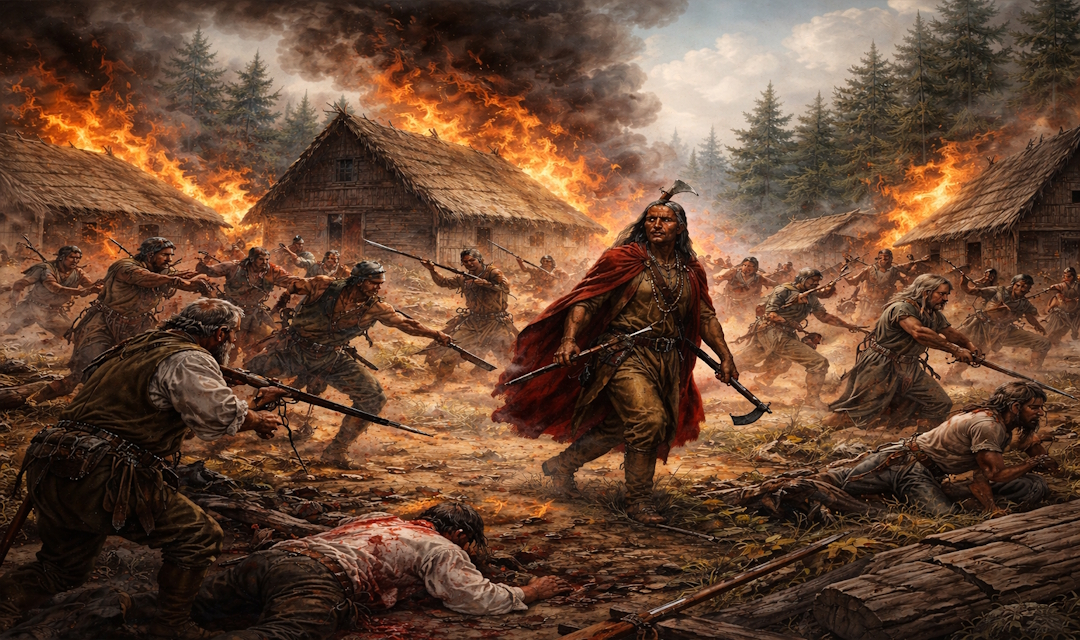
Shortly afterward, violence broke out. The war began with a series of coordinated attacks on frontier settlements, beginning with the burning of Swansea in 1675. These early attacks shocked colonial society and demonstrated the effectiveness of Indigenous military tactics. Rather than engaging in set-piece battles, Indigenous forces used mobility, surprise, and deep knowledge of the terrain to conduct rapid raids on isolated farms and villages. They struck quickly and withdrew into forests, wetlands, and difficult terrain where English militia forces struggled to pursue them effectively.
The early phase of the war saw rapid escalation. Settlements across the frontier were attacked, burned, or abandoned. Colonial populations retreated toward coastal towns, where they could be more easily defended. Fear spread quickly, and the sense of security that had previously characterized English expansion into the region collapsed almost overnight. In many areas, colonial authority broke down entirely as communication between settlements became dangerous or impossible.
As the conflict expanded, more Indigenous groups became involved. The war was no longer limited to the Wampanoag. Communities such as the Nipmuc and later the Narragansett were drawn into the fighting through a combination of alliance, pressure, and defensive necessity. Some groups joined Metacom’s resistance, while others attempted to remain neutral but were eventually forced into conflict as the war spread across their territories. The result was a regional war that engulfed much of New England and involved multiple Indigenous nations with different interests and strategies.
The English response evolved rapidly in reaction to the scale of the conflict. Colonial governments organized militias across different settlements, strengthened frontier defenses, and built fortified garrison houses designed to protect civilians during attacks. These structures became central to colonial survival during the war, allowing small communities to withstand raids that might otherwise have destroyed them completely.
Another important development in the English response was the use of Indigenous allies. Colonial forces recruited rival Indigenous groups who had their own political and territorial conflicts with Metacom’s coalition. This strategy significantly altered the balance of the war, turning it into a multi-sided conflict in which Indigenous groups fought on both sides depending on local circumstances. This fragmentation of Indigenous alliances weakened the overall coherence of resistance and contributed to the eventual outcome of the war.
One of the most significant turning points in the conflict occurred in late 1675 during the Great Swamp Fight. Colonial forces launched a large-scale winter assault on a fortified Narragansett settlement in what is now Rhode Island. The attack took place under extremely harsh conditions, including deep snow and freezing temperatures that made movement and combat difficult for both sides. Despite these conditions, colonial forces succeeded in breaching and burning the settlement. The result was the deaths of a large number of Narragansett people, including many non-combatants.
Although the English viewed this engagement as a decisive military victory, its broader consequences were more complex. Rather than ending resistance, the destruction of the Narragansett settlement pushed previously neutral or cautious groups into active opposition. The war therefore intensified rather than concluded, expanding the scale of conflict across the region.
By 1676, the King Philip’s War had reached its most intense phase. Metacom attempted to sustain a coordinated resistance campaign across multiple regions, aiming to disrupt colonial expansion and force political concessions. His strategy relied on mobility, surprise, and the ability to coordinate dispersed groups of warriors across large distances. However, this strategy was increasingly undermined by logistical challenges. Indigenous forces faced shortages of food and ammunition, as colonial forces disrupted supply lines and destroyed agricultural settlements. At the same time, internal divisions within the coalition made sustained coordination difficult.
One of the most notable engagements of this period was the ambush at Bloody Brook, where colonial troops were attacked during a supply movement and suffered heavy casualties. While such attacks demonstrated that Indigenous forces could still inflict significant damage, they did not alter the overall strategic direction of the war. The English gradually gained the upper hand through improved coordination, increased manpower, and the continued use of Indigenous allies.
As the war progressed further, Indigenous resistance became increasingly fragmented. Communities were displaced, villages destroyed, and populations forced into flight or starvation. Without centralized command and under severe environmental and military pressure, many groups were no longer able to sustain organized resistance. Metacom himself became more isolated as his network of allies weakened and collapsed.
The King Philip’s War effectively ended in the summer of 1676 with the death of Metacom near Mount Hope. He was killed by colonial forces assisted by Indigenous allies, marking the collapse of coordinated resistance. His death was treated by English colonists as both a military and symbolic victory. His body was publicly displayed and dismembered as a warning to others, reflecting the intensity of fear and hostility that had developed during the conflict.
Although isolated fighting continued for a short time afterward, the war was effectively over. The consequences of King Philip’s War were catastrophic for Indigenous populations in southern New England. Entire communities were destroyed or permanently displaced. Many survivors were absorbed into other Indigenous groups, forced into exile, or sold into slavery and transported to distant colonies such as those in the Caribbean. The demographic and political landscape of the region was permanently transformed.
For the English colonies, victory came at a significant cost. Many settlements had been destroyed, frontier regions had collapsed, and colonial economies were severely disrupted. The psychological impact of the war was profound, as colonists had experienced the vulnerability of their settlements and the possibility of complete destruction. However, in the aftermath of the war, English expansion accelerated significantly, as resistance in southern New England had been largely broken.
In historical interpretation, the war is now understood not as a simple colonial victory, but as a catastrophic breakdown of coexistence between two societies under increasing structural pressure. It was a conflict shaped by land disputes, cultural misunderstanding, political imbalance, and escalating cycles of retaliation. The leadership of Metacom is often reinterpreted in modern scholarship not merely as rebellion, but as a response to the rapid erosion of Indigenous sovereignty and autonomy.
Ultimately, King Philip’s War marked a decisive turning point in the history of New England. It ended the early period of fragile coexistence and ushered in a new era of colonial dominance and Indigenous displacement. It remains one of the most important and tragic conflicts in early American history, illustrating how quickly fragile peace can collapse when political, economic, and cultural pressures become unsustainable.