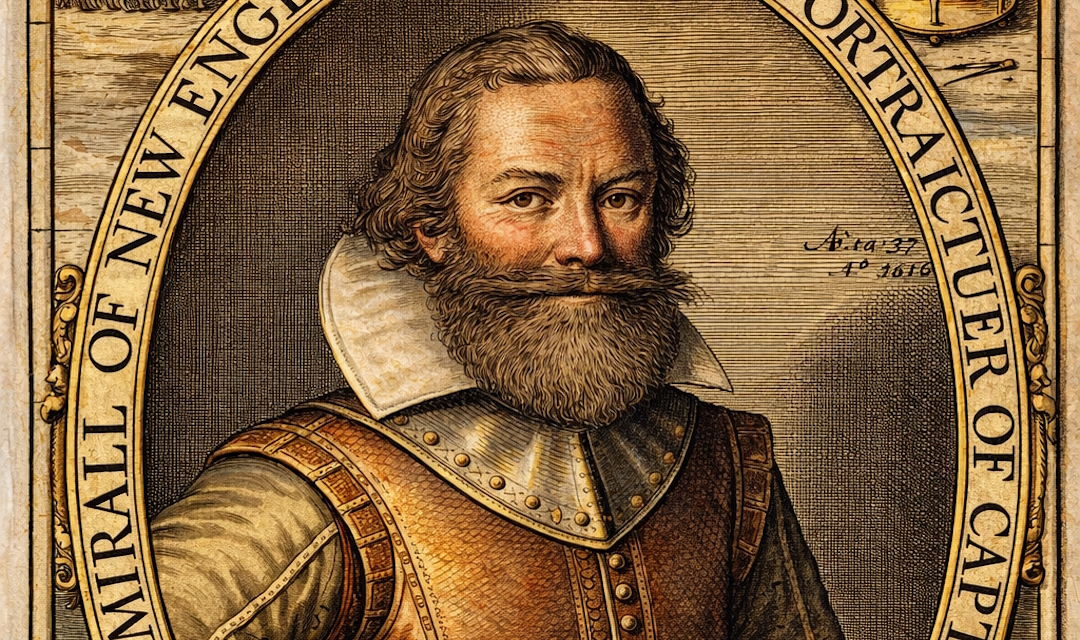
The figure of John Smith sits at the center of the early history of Jamestown, but the man who appears in popular memory is not the same as the man who operated inside the colony’s fragile survival system.
Over time, Smith became a symbol of decisive leadership in a collapsing settlement. In reality, his influence was real—but narrower, more contested, and far more dependent on circumstance than the myth suggests.
Below is a clear separation between legendary Smith and historical Smith, and how both emerged from the same survival crisis.
1. Myth: John Smith “Saved Jamestown”
Popular narrative:
Smith is often portrayed as the man who single-handedly rescued Jamestown from collapse through discipline, negotiation, and personal bravery.
Reality:
By the time Smith took a leading role (1608–1609), the colony was already:
- structurally unstable
- dependent on Indigenous food systems
- suffering high mortality from disease and malnutrition
He did not “save” the colony in isolation. Instead, he:
- stabilized internal discipline temporarily
- improved food procurement efficiency
- and reduced waste during extreme scarcity
But the system remained fundamentally fragile.
Jamestown survived not because it was saved, but because it was continuously restructured under crisis.
2. Myth: “He that will not work shall not eat” Created Order
Popular narrative:
Smith imposed strict labor discipline that transformed chaos into productivity.
Reality:
The policy was less ideological revolution and more emergency logistics.
The colony faced:
- labor refusal from gentlemen settlers unused to manual work
- extremely low food production
- total dependence on external supply or Indigenous trade
Smith’s enforcement worked because:
- there was no surplus to allow non-workers to exist
- starvation was immediate and visible
So the rule was not moral reform—it was energy accounting under collapse conditions.
It only functioned while enforcement was physically possible.
3. Myth: Smith Had Stable Authority Over the Colony
Popular narrative:
Smith is often described as a commander with unified control.
Reality:
Authority in Jamestown was fragmented and constantly contested:
- the Virginia Company in London issued competing instructions
- internal factions resisted discipline
- leadership rotated frequently due to illness and crisis
- armed conflict and political tension were constant
Smith’s authority was:
- situational
- dependent on supply conditions
- and often undermined by rival settlers
He governed more like a crisis manager than a sovereign leader.
4. Myth: He Mastered Indigenous Relations Through Diplomacy Alone
Popular narrative:
Smith is often credited with skillful diplomacy that stabilized relations with the Powhatan Confederacy.
Reality:
Relations were never stable or purely diplomatic.
What actually occurred:
- intermittent trade relationships based on necessity
- food exchanges under pressure, not trust
- periodic raids and retaliations on both sides
Smith’s interactions were shaped by:
- English desperation for food
- Indigenous strategic control of maize supply
- constant intelligence gathering on both sides
Diplomacy functioned as:
a survival mechanism, not a peace system.
5. Myth: The Pocahontas Story as a Central Turning Point
Popular narrative:
Smith is often placed at the center of a dramatic rescue narrative involving Pocahontas.
Reality:
Modern historians widely question the accuracy of this event as it is popularly told.
What is more reliable:
- Smith’s accounts were written years later
- the story changes across versions of his writings
- Indigenous records do not confirm the romanticized rescue framing
Most likely, the event—if it occurred—was:
- a political ritual or symbolic adoption scenario
- rather than a dramatic execution rescue scene
The myth grew later as part of colonial storytelling, not as a contemporaneous strategic event.
6. Myth: Smith Was the Primary Architect of Jamestown’s Survival
Popular narrative:
Smith is often treated as the central engineer of survival systems.
Reality:
Survival depended on multiple overlapping systems:
- Indigenous maize networks controlled by the Powhatan Confederacy
- environmental adaptation (learning local agriculture)
- intermittent resupply from England
- collective labor from settlers under extreme coercion
- later, tobacco economy restructuring after Smith’s departure
Smith contributed to coordination, but:
no single actor controlled the survival architecture of Jamestown.
7. Myth: His Leadership Was Continuous and Long-Term
Popular narrative:
Smith is imagined as a long-term governor shaping the colony’s destiny.
Reality:
Smith’s active leadership period in Virginia was relatively short (roughly 1608–1609).
He left after injury from a gunpowder accident and political conflict.
After his departure:
- Jamestown entered the “Starving Time”
- governance destabilized further
- survival collapsed into near-total breakdown
This shows his role was temporary stabilization, not long-term institutional design.
8. The Real John Smith: Crisis Operator in a Failed System
If stripped of myth, Smith’s actual role becomes clearer:
He was:
- a disciplinarian under extreme scarcity
- a coordinator of food extraction under dependency conditions
- a negotiator operating inside Indigenous-controlled supply networks
- a political figure constantly constrained by structural instability
He was not a founder of order, but a manager of collapse delay.
Core Insight
The mythology of John Smith exists because Jamestown required retrospective meaning-making.
In reality:
Smith did not solve Jamestown’s survival crisis—he operated inside it, temporarily slowing its breakdown while relying heavily on systems he did not control, especially Indigenous food networks and fragile colonial logistics.
The myth simplifies a chaotic reality into a single heroic figure. The reality is far more structural: survival was distributed across ecology, Indigenous diplomacy, forced labor systems, and constant improvisation under collapse conditions.
The myth and reality of John Smith become much clearer when we expand the frame beyond individual anecdotes and place him inside the full collapse ecology of Jamestown. What emerges is not a heroic founder narrative, but a pattern of survival improvisation inside a system that was already structurally unstable before he ever gained influence.
To understand why Smith became mythologized at all, you have to start with a simple mismatch: English colonial expectations were built on ideas of controlled expansion, but Virginia in the early 1600s operated under conditions of scarcity, disease, fragmented authority, and constant dependency on Indigenous food systems controlled by the Powhatan Confederacy. In that environment, even small moments of temporary stabilization could appear, in hindsight, like decisive leadership.
1. The Myth-Making Machine Begins in Real Time
Smith’s reputation did not begin after his death—it began during the crisis itself.
The Virginia Company in London needed:
- success narratives to justify investment
- identifiable leaders to explain chaotic reports
- simplified stories that turned survival into progress
So early accounts already favored:
- dramatic leadership figures
- moral discipline narratives
- and simplified “turning point” explanations
Smith, who wrote extensively about his experiences, became a natural focal point because he was literate, self-promoting, and actively shaping his own narrative.
This matters:
Smith did not just survive Jamestown—he documented it in a way that shaped how it would later be remembered.
2. The Reality of Authority: Fragmented, Not Command-Based
In practice, Smith’s authority was never absolute. Jamestown governance functioned more like a rotating emergency committee under siege conditions than a stable military command structure.
He had to operate within:
- shifting leadership appointments from London
- resistance from “gentlemen” settlers who rejected manual labor
- constant attrition from disease and malnutrition
- unclear jurisdiction between military and civilian authority
So when Smith enforced discipline, it was not the expression of centralized control—it was localized enforcement inside a collapsing hierarchy.
The famous rule:
“He that will not work shall not eat”
was effective only because:
- starvation was already immediate
- labor refusal directly threatened survival
- there was no surplus to absorb non-productivity
It was less a governance philosophy and more a real-time survival constraint.
3. Survival Was Actually Dependent on Indigenous Systems
One of the most distorted aspects of Smith’s myth is the idea that English survival was internally generated.
In reality, early Jamestown was structurally dependent on:
- maize agriculture systems managed by Indigenous communities
- seasonal food surplus distribution
- controlled trade through Powhatan political networks
The Powhatan Confederacy functioned as the primary stabilizer of colonial survival during multiple crisis windows.
Smith’s interactions with Indigenous groups were therefore not just diplomacy—they were logistical negotiations for caloric survival.
This creates a crucial inversion:
Smith did not “secure food from Indigenous people” as a conqueror. He negotiated access to systems that already controlled regional food security.
4. The Illusion of “Control” in a Non-Control Environment
One of the biggest myths is that Smith imposed order on chaos.
But Jamestown itself was not an order-versus-chaos environment. It was:
- a fragile European settlement inserted into an already functioning ecological and political system
- operating with limited understanding of local agriculture, disease ecology, and seasonal cycles
Smith’s interventions worked only in narrow domains:
- enforcing short-term labor compliance
- coordinating limited expeditions for food acquisition
- attempting to stabilize internal discipline
But he could not control:
- disease cycles (“seasoning” mortality patterns)
- climate variability affecting crops
- Indigenous strategic responses
- supply failures from England
So his “control” was actually:
intermittent influence over a system whose main variables were outside English control.
5. Why the Pocahontas Narrative Became Central
The later mythologization of Smith is heavily shaped by storytelling, especially around the Pocahontas episode.
Regardless of its historical complexity, what matters for myth-making is not accuracy but narrative structure:
- a powerful leader in danger
- a dramatic intervention
- a moment of cross-cultural connection
- survival against odds
This type of story is extremely useful for colonial-era narrative building because it:
- humanizes expansion
- softens conflict history
- and centers English survival on individual virtue rather than structural dependence
In reality, however, the survival of Jamestown was not determined by singular dramatic events but by repeated cycles of food negotiation, labor coercion, and fragile trade stabilization.
6. Departure and the Collapse of the “Smith Effect”
Smith’s departure from Virginia in 1609 (after injury and political conflict) is often treated as a side note—but structurally, it is critical.
After he left:
- Jamestown entered its most catastrophic phase (the “Starving Time”)
- internal discipline deteriorated further
- dependency on external supply chains became total
This reveals something important:
Smith’s leadership did not transform Jamestown into a stable system—it temporarily delayed systemic collapse.
His absence did not “cause” failure, but it exposed how fragile the underlying structure already was.
7. The Core Myth vs Reality Contrast
Myth John Smith:
- decisive founder
- master strategist
- stabilizer of chaos
- central architect of survival
- symbolic bridge between cultures
Real John Smith:
- crisis manager in a collapsing settlement
- enforcer of survival labor discipline under extreme scarcity
- negotiator operating inside Indigenous-controlled food systems
- temporary stabilizing actor in a structurally unstable colony
- one voice among fragmented and competing authorities
Final Insight
The enduring myth of John Smith exists because early Jamestown required simplification.
But the real history of Jamestown is not about individual heroism. It is about systems under stress:
- ecological miscalculation
- dependency on Indigenous agricultural networks
- fragile transatlantic logistics
- internal labor conflict
- and repeated cycles of starvation and adaptation
Smith becomes “legendary” not because he controlled this system, but because he briefly operated inside it at moments when survival was hanging by the smallest possible margins—and later told the story in a way that made those moments look like turning points.
JAMETOWN SURVIVAL SYSTEM FAILURE TIMELINE (1608–1609)
Context baseline (1607–early 1608)
Before Smith consolidates leadership:
- High mortality from disease (“seasoning” phase)
- Weak agricultural output
- Fragmented leadership
- Heavy dependence on Indigenous food trade via the Powhatan Confederacy
Systems are already unstable—Smith inherits partial collapse, not stability.
WATER & SANITATION SYSTEM COLLAPSE (1607–1608, ongoing into Smith’s rise)
What fails:
- Reliance on river water (brackish + contaminated)
- No filtration or sanitation system
- Waste contamination inside settlement perimeter
During Smith’s leadership:
- Wells are attempted but inconsistent and vulnerable to drought/salt intrusion
- Disease remains endemic (dysentery, typhoid-like symptoms)
Outcome:
Water system never stabilizes
Chronic illness reduces labor force permanently
Effect on other systems:
- labor productivity drops
- food procurement weakens
- military readiness declines
FOOD PRODUCTION SYSTEM FAILURE (1608 peak crisis)
What exists:
- Small-scale European-style farming attempts
- Limited adaptation to Indigenous agriculture
What breaks:
- Soil mismatch (European wheat fails in Virginia ecology)
- Lack of seasonal planning knowledge
- No stored surplus infrastructure
During Smith’s intervention:
- forced labor increases food gathering efficiency
- reliance on trade with Powhatan villages intensifies
Outcome:
Agriculture never becomes primary food source
Survival becomes externally dependent
Key dependency shift:
Jamestown transitions from farming colony → extractive trade-dependent outpost
DIPLOMATIC TRADE SYSTEM BREAKDOWN (late 1608–1609)
This is the most important collapse layer.
System function:
- maize trade with Powhatan villages
- exchange of copper, tools, beads
Failure mechanism:
- English expansion increases tension
- armed raids begin replacing trade interactions
- Indigenous groups restrict food supply strategically
During Smith’s leadership:
- trade is still partially functional but unstable
- he uses coercion + negotiation mix to maintain flow
Outcome:
Trade becomes conditional and weaponized
No longer reliable survival mechanism
Effect:
- immediate starvation risk during winter cycles
- colonial dependence becomes politically exposed
LABOR DISCIPLINE SYSTEM (PARTIAL SUCCESS, STRUCTURAL FAILURE)
Smith’s reform:
- “work or starve” enforcement
- abolition of idle gentleman privilege
- forced communal labor structure
What works:
- short-term increase in output
- improved fort construction
- better expedition coordination
What fails:
- no long-term incentive system
- resentment among elite settlers
- enforcement depends on Smith’s presence
Outcome:
Labor system is coercive, not sustainable
collapses immediately when authority weakens
SECURITY / MILITARY SYSTEM (FRAGILE STABILITY → ESCALATION)
Structure:
- small militia inside palisade fort
- ad hoc patrols outside settlement
- no standing army logistics
During Smith’s leadership:
- improves defensive coordination
- reduces internal disorder
- maintains deterrence posture
Failure trigger:
- reliance on food raids increases conflict exposure
- security becomes tied to food acquisition missions
Outcome:
military system becomes extension of food crisis management
not a separate defense structure
GOVERNANCE SYSTEM FAILURE (CONSTANT UNDERMINING)
Structure:
- Virginia Company authority in England
- rotating colonial leadership
- Smith as temporary central coordinator
Failure points:
- conflicting instructions from England
- leadership disputes among settlers
- lack of legal enforcement mechanisms
During Smith’s leadership:
- temporary centralization occurs
- authority is personal, not institutional
Outcome:
governance collapses into personality-based command
disappears when Smith leaves (1609)
OVERALL SYSTEM INTEGRATION FAILURE (1609 CRITICAL POINT)
By 1609, all survival systems are still technically present—but no longer integrated.
Instead of a functioning system, Jamestown becomes:
- Water system → broken (illness baseline)
- Food system → externally dependent
- Trade system → unstable and politicized
- Labor system → coercive and fragile
- Military system → tied to food raids
- Governance system → personal authority only
Final cascade:
When supply ships fail and trade collapses simultaneously:
ALL systems fail at once → “Starving Time” follows immediately after Smith’s departure
CORE INTERPRETATION (WHY THIS MATTERS)
During Smith’s leadership, nothing is truly “fixed.”
Instead:
He acts as a temporary synchronization layer between collapsing systems.
When he is present:
- systems partially align under pressure
- survival is possible but unstable
When he leaves:
- synchronization disappears
- systems collapse into isolation
- starvation becomes unavoidable
FINAL STRUCTURAL INSIGHT
The failure timeline shows a key truth about Jamestown:
It was never a single-system colony. It was a bundle of broken systems temporarily held together by crisis leadership and Indigenous resource networks controlled by the Powhatan Confederacy.
And John Smith did not prevent collapse—he delayed system desynchronization long enough for survival to remain barely possible.