Christopher Columbus is one of the most infamous figures in world history. For centuries, he has been portrayed as a bold navigator, a brilliant pioneer, and the man who discovered America. Yet when we look deeper at his life, voyages, and the historical record, a much more complex — and often troubling — picture emerges: Columbus’s fame rests partly on chance, miscalculation, myth‑making, and later reinterpretations, rather than purely on skill and knowledge.
What follows is a thorough examination of his voyages, errors, lesser‑known stories, and how the legend of Columbus was constructed over time.
Columbus’s Original Goal: The Indies, Not America
Christopher Columbus did not set out to find a “New World” or a previously unknown continent. His explicit aim was to find a westward route to Asia, specifically to the rich trading regions known as the Indies — the lands of spices and silks coveted by European merchants.
Columbus’s idea was based on a miscalculation of the Earth’s circumference and geography. He thought the distance from Europe to Asia across the Atlantic was much shorter than it actually was, largely because he underestimated the size of the globe. His figures were based on earlier sources — especially the work of the Greek geographer Ptolemy and the ideas of the Italian mathematician and cartographer Paolo dal Pozzo Toscanelli — but these sources contained significant errors. Columbus believed he could reach Asia in a matter of weeks rather than the months it would actually take.
In reality, the distance from the Canary Islands to Asia is more than 13 000 km. Columbus expected it to be only around one‑fifth that, placing Asia just beyond the Atlantic. He planned — based on incorrect numbers — to complete a crossing that, if he had actually reached Asia, would have been impossible with the food, water, and technology available at the time.
This error meant that the only reason his fleet found land at all was the existence of a massive landmass — the Americas — in an unexpected place. If the Americas were not there, his first voyage would likely have ended in starvation and loss at sea.
The Myth of the Flat Earth — A False Narrative
A common myth is that Columbus succeeded because he believed in a flat Earth and set out hoping to reach Asia in a straight line across the Atlantic. This is not accurate. The idea that medieval and Renaissance scholars thought the Earth was flat is itself a myth propagated later by 19th‑century writers — including Washington Irving, whose popular (but ahistorical) biographies spread the idea.
In fact, educated Europeans in Columbus’s time already understood that the Earth was round. The real debate was not about the shape of the Earth but about its size and the distance across the ocean. Most scholars, including those in Portugal (which had a strong maritime tradition), believed that a westward route to Asia was far too distant to be practical. It was Columbus’s own misinterpretation of data that led him to believe otherwise.
This makes his voyage remarkable not because of extraordinary insight into global geography, but rather because he was determined to act on an erroneous assumption that others had rejected.
Mistakes and Mismanagement on the First Voyage
Many dramatic moments of Columbus’s first voyage illustrate both the luck and the missteps involved:
a) The Santa María Shipwreck
During the first voyage across the Atlantic in 1492, Columbus commanded three ships: the Santa María, Pinta, and Niña. On 24 December 1492, the flagship Santa María ran aground on a sandbank off the coast of present‑day Haiti while Columbus was below deck resting. The ship was lost, and Columbus ordered it dismantled so its timbers could be used to build a fort called La Navidad.
This incident reveals a significant lapse in seamanship or oversight. A sandbank encountered while the captain was asleep would be described today as poor navigation or inadequate command vigilance, yet it happened early in the voyage and Columbus managed to turn it into a colonial foothold.
b) Avvistamenti di luce
The night before landfall in October 1492, crew members reported seeing lights at sea — described as “like a candle flickering.” This was taken as a sign of nearby land. Whether this was bioluminescence, distant birds, or ephemeral natural lights, the incident has entered legend and was rewarded by the Spanish crown.
Stories like this demonstrate how uncertain navigation was and how chance observations could shape the narrative of discovery.
Limited Geographic Awareness and Navigation Skill
Columbus lacked the navigational tools and geographical data that later explorers would use. For example:
Longitude (east‑west position) could not be accurately measured at sea in Columbus’s time. This meant explorers could determine north–south latitude by the North Star but not their exact position east–west.
Columbus navigated primarily by dead reckoning, compass headings, and observation of stars — methods that carried inherent inaccuracies.
The idea of reaching Asia across an uninterrupted ocean was acknowledged as implausible by many contemporary scholars, including Portuguese navigators.
Columbus persisted because he was confident his numbers were correct — even though they were not — and his success was only possible because the continents he encountered lay in the way. Otherwise, his fleet would have continued west into an empty ocean with no landfall for weeks or months.
When “Discovery” Met Indigenous Civilizations
Columbus did not “discover” an empty land. The Americas were already populated by millions of Indigenous peoples with complex civilizations — the Aztec, Maya, Inca, and countless others in North America. His voyage intersected with societies that had their own histories stretching back millennia.
Columbus’s own impressions, recorded in his diary and letters, show his misunderstanding and utilitarian evaluation of the native peoples he encountered. He described them as timid and lacking weapons, and suggested they could be easily converted to Christianity or made subject to Spanish rule — a view shaped more by colonial ambition than genuine observation.
He wrote bluntly about how Indigenous people were “well made” and exchanged goods readily, imagining they would make good servants and be simple to dominate. That perspective foreshadowed patterns of exploitation and violence that would soon follow European contact.
Beyond the First Voyage: Later Expeditions and Resistance
Columbus embarked on a total of four transatlantic voyages between 1492 and 1504:
Second voyage (1493–1496): A significantly larger fleet of 17 ships was sent to colonize. The settlement La Isabela was founded on Hispaniola but struggled due to poor planning, disease, and hostility.
Third voyage (1498–1500): Columbus reached parts of the South American mainland (coasts of modern Venezuela). However, his governance became controversial and harsh, leading to conflicts with colonists and Indigenous peoples alike.
Fourth voyage (1502–1504): He explored Central America but was unable to find a passage to Asia. This voyage was plagued with storms, ship damage, and declining support.
Columbus also faced accusations of mismanagement and cruelty in the colonies, which led to his temporary arrest and removal from authority by the Spanish Crown.
Myths and Misattributions
Over time, myths about Columbus have proliferated, many of which mask or distort historical reality:
a) Myth: He Proved the Earth Was Round
This is false. Educated Europeans in the 15th century already knew the Earth was spherical due to ancient Greek science. The issue was not shape but scale.
b) Myth: He Was the First European in America
Long before Columbus, Norse explorers — especially Leif Erikson and others in the Viking age — reached parts of North America around 1000 CE, nearly 500 years before Columbus.
c) Myth: He Was a Brilliant Navigator
The truth is more nuanced: Columbus was persistent and determined, but he lacked certain navigational skills compared to Portuguese explorers of his time and relied heavily on mistaken assumptions.
Legacy: Myth, History, and Evaluation
Columbus’s overall legacy is complex and contested:
Historical impact: His voyages did open sustained contact between Europe and the Americas, triggering large‑scale exploration, colonization, and the eventual rise of global empires.
Moral evaluation: Many historians criticize Columbus for his treatment of Indigenous peoples and his role in initiating patterns of exploitation and violence.
Myth vs. reality: Much of what popular culture remembers — heroic explorer, brave navigator — is shaped by later storytelling and nationalism rather than sober historical evidence.
In truth, Columbus’s fame arises from a confluence of chance, timing, political support, and subsequent myth‑making, rather than purely from navigational genius or strategic foresight.
Conclusion: Luck, Error, and Historical Reputation
Christopher Columbus was undoubtedly a major historical figure, but not in the simplistic way traditional narratives paint him. His success in crossing the Atlantic and encountering new lands was heavily dependent on:
An incorrect understanding of global geography.
The fortuitous presence of continents in the Atlantic’s path.
Support from the Spanish Crown at a moment of geopolitical opportunity.
The early printing and dissemination of his letters across Europe.
His mistakes, miscalculations, and controversies are as historically significant as his achievements — if not more so — because they reveal how historical reputation can be shaped by accident and later interpretation rather than sheer brilliance.
First Voyage (1492–1493): A Mistaken “Discovery”
Background
Columbus’s aim was not to find a new continent; he wanted a westward route to Asia—the Indies—to access spices, silk, and wealth. Because the Ottoman Empire’s expansion had disrupted overland trade routes from Europe to Asia, European monarchs were eager for alternative sea routes. Columbus argued that sailing west would reach Asia faster and more profitably.
But he was wrong about distance and direction: Columbus believed the Earth’s circumference was smaller than it is, and that Asia was much closer across the Atlantic than reality showed. This miscalculation was not a universally accepted geographic truth; many scholars and navigators, including those in Portugal, believed the Atlantic crossing was impractically long.
The Voyage
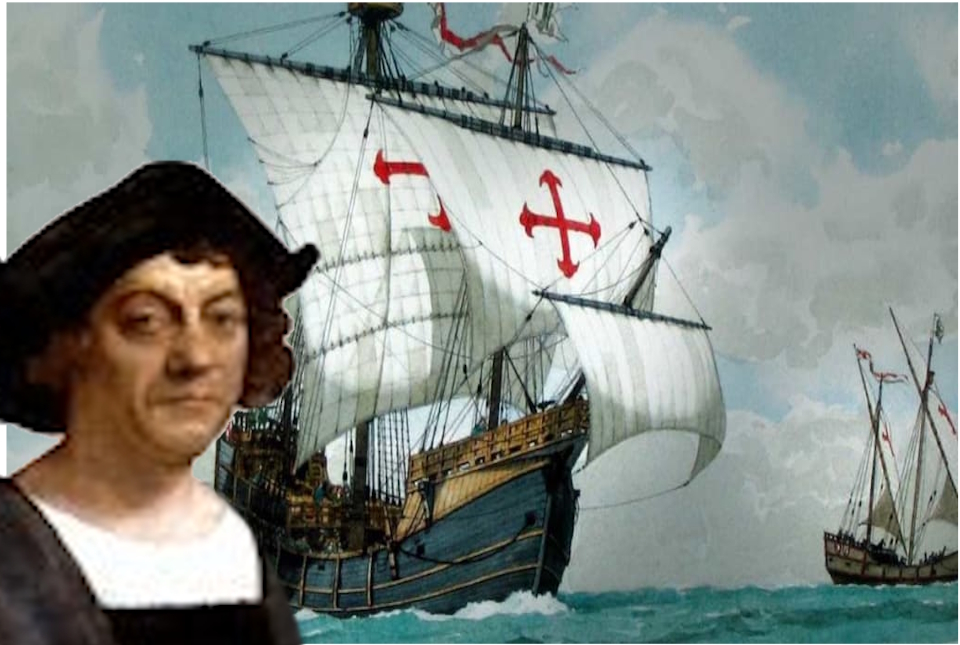
Columbus set sail on 3 August 1492 from Palos, Spain, with three ships: the Niña, the Pinta, and the Santa María. The crew was anxious, fearing they would never see land again. After a grueling 33‑day voyage, they finally sighted land on 12 October 1492, an island in the Bahamas Columbus named San Salvador.
Mistakes and Misinterpretations
From the beginning, Columbus misinterpreted what he saw:
-
He believed he had reached Asia. Even after landing in the Bahamas, exploring Cuba, and reaching Hispaniola, he remained convinced he was on the fringes of Asia. He never realized he had stumbled upon entirely new continents.
-
His navigational techniques were limited. Columbus relied on dead reckoning and rudimentary maps, and his estimates of longitude were wildly inaccurate—he didn’t have a way to calculate exact east‑west position at sea.
La Navidad and Luck
On 25 December 1492, the Santa María ran aground off Hispaniola and was lost. Instead of returning to Spain immediately, Columbus ordered the ship broken up and used its timbers to build a small fort named La Navidad, leaving 39 men behind as colonists.
This decision was a mix of mistake and luck:
-
Mistake: He left an ill‑prepared group of men who didn’t establish stable relations with Indigenous peoples.
-
Luck: The wood, men, and temporary base gave Columbus something tangible to report back to the Crown.
Unfortunately, when Columbus returned on his second voyage, La Navidad had been destroyed by Indigenous resistance due to conflict with the settlers.
Analysis: The voyage’s success relied heavily on chance landfall and timing, rather than accurate navigation. Without the islands in his path, he could have been lost at sea.
Second Voyage (1493–1496): Colonization, Conflict, and Mismanagement
Background
Encouraged by the first trip, the Spanish Crown sponsored a much larger second expedition—17 ships and about 1 500 men.
Instead of exploration alone, this voyage was designed for colonization and extracting wealth and trade goods.
What Happened
Columbus landed again in Hispaniola, only to find La Navidad destroyed. The early settlers had antagonized local Indigenous groups, partly due to cultural misunderstandings and exploitation.
Columbus then:
-
Founded La Isabela, the first European town in the Americas (formally established 6 January 1494).
-
Forced Indigenous peoples into hard labor and tribute.
-
Tried to extract gold, expecting vast quantities that did not materialize.
Lesser‑Known Stories
One of the most striking events happened in March 1495 at the Battle of Vega Real (also called the Battle of Holy Hill), where Columbus, his brother Bartholomew, and other captains defeated an alliance of Taíno leaders, including Caonabo, Guarionex, Cayacoa, and Bohechío. The victory ended much Indigenous resistance on Hispaniola; Spanish forces reportedly had no men killed, while dozens of Indigenous warriors died.
This battle illustrated several things:
-
Spanish forces used Indigenous allies as well, led by local chief Guacanagaríx.
-
The conflict marked a transition from early contact to violent domination.
Analysis: The second voyage highlighted Columbus’s limitations as an administrator and his lack of understanding of local conditions. While larger in scope, it produced mixed results: more land was claimed, but settlements faced failure.
Third Voyage (1498–1500): South America and Loss of Authority
Exploration and Surprise Discoveries
On his third voyage, Columbus finally reached the mainland of South America, near the Orinoco Delta in present‑day Venezuela. Although he still thought this land was part of the Asian continent, this was the first known European encounter with the South American mainland.
This was both an achievement and a mistake. He was exploring further west than ever before, yet still misidentified the nature of the land he found.
Crisis in Hispaniola
Returning to Hispaniola, Columbus found chaos:
-
Settlements were unstable.
-
Relations with Indigenous peoples were deteriorating.
-
Many colonists complained about Columbus’s leadership.
By 1500, the Crown sent Francisco de Bobadilla to investigate reports of mismanagement. Columbus was arrested and sent back to Spain in chains. He was stripped of most authority and privileges, though later pardoned to a degree.
This episode — one of the most overlooked in popular narratives — shows how Columbus’s leadership was not universally admired, even by his sponsors.
Analysis: The third voyage combined lucky continental discovery with serious administrative failure. Columbus’s navigation led him to new lands, but governance issues undermined the mission.
Fourth Voyage (1502–1504): Central America, Shipwrecks, and Stranding
Final Attempt for Asia
Columbus’s fourth voyage was meant to prove that he could still find a westward passage to Asia. Instead, he explored the coastlines of Central America — including modern Honduras, Nicaragua, and Panama — looking for a strait connecting the Atlantic to the Indian Ocean.
He failed.
Shipwrecks and Survival
On this voyage, his fleet suffered significant damage:
-
Worms known as teredos bored into the hulls.
-
Storms damaged the remaining ships.
-
Eventually, Columbus and his men were stranded in Jamaica for about a year. Without seaworthy vessels, they survived largely through negotiation and pressure on local Indigenous communities before being rescued and returned to Spain.
Analysis: Columbus’s final voyage demonstrates the limits of his navigational knowledge and persistent optimism, but also his resilience and survival skills. Despite repeated failures to reach Asia or maintain stable colonies, he returned to Spain alive.