King Philip’s War was not a sudden or isolated conflict, but the result of decades of mounting pressure, cultural misunderstanding, and irreversible change in New England. At the heart of this transformation stood Metacom, the son of Massasoit, a leader who had once maintained a fragile but functional peace with the English settlers. In the early years of colonization, cooperation had been essential. Indigenous communities had helped the English survive, sharing knowledge about agriculture, local resources, and the rhythms of the land. But by the 1670s, this relationship had fundamentally changed. The English were no longer weak and dependent; they had grown in number, confidence, and ambition, and they began to reshape the region according to their own systems of ownership and control.
The most profound source of tension lay in the different ways land was understood. For Indigenous communities, land was not something that could be permanently owned or divided. It was a shared space, used collectively for hunting, farming, and seasonal movement. These practices were deeply connected to cultural identity and survival. The English, however, brought a radically different concept. Land was property—something to be surveyed, enclosed, and exploited for long-term economic gain. As settlements expanded, forests were cleared, fields fenced, and access to rivers and hunting grounds restricted. What appeared to the English as progress and development felt to Indigenous communities like a slow and deliberate suffocation of their way of life.
At the same time, the spread of Christianity added another layer of complexity. English missionaries established settlements known as “Praying Towns,” where Indigenous converts were expected to adopt English customs, religion, and ways of living. While some individuals chose this path as a means of survival or adaptation, these communities created deep divisions within tribes. Families were split between those who embraced change and those who resisted it. Traditional leadership structures were weakened, and colonial authorities increasingly intervened in Indigenous affairs. Leaders like Metacom found their power undermined not only by external pressure, but also by internal fragmentation.
The situation became even more volatile as English legal systems began to assert dominance over Indigenous populations. Disputes that had once been resolved within tribal structures were now handled in colonial courts, where Indigenous leaders had little authority. This shift represented more than a legal change—it was a direct challenge to sovereignty. The breaking point came in 1675 with the death of John Sassamon, a Christianized Native who had warned the English about rising tensions. When his body was discovered, the English accused three Wampanoag men of murder. They were tried and executed by colonial authorities. To the English, this was a demonstration of law and order. To Metacom, it was a clear sign that his authority had been stripped away and that his people were now subject to foreign rule.
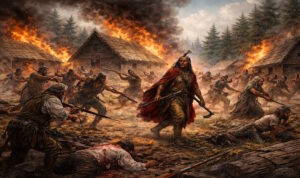
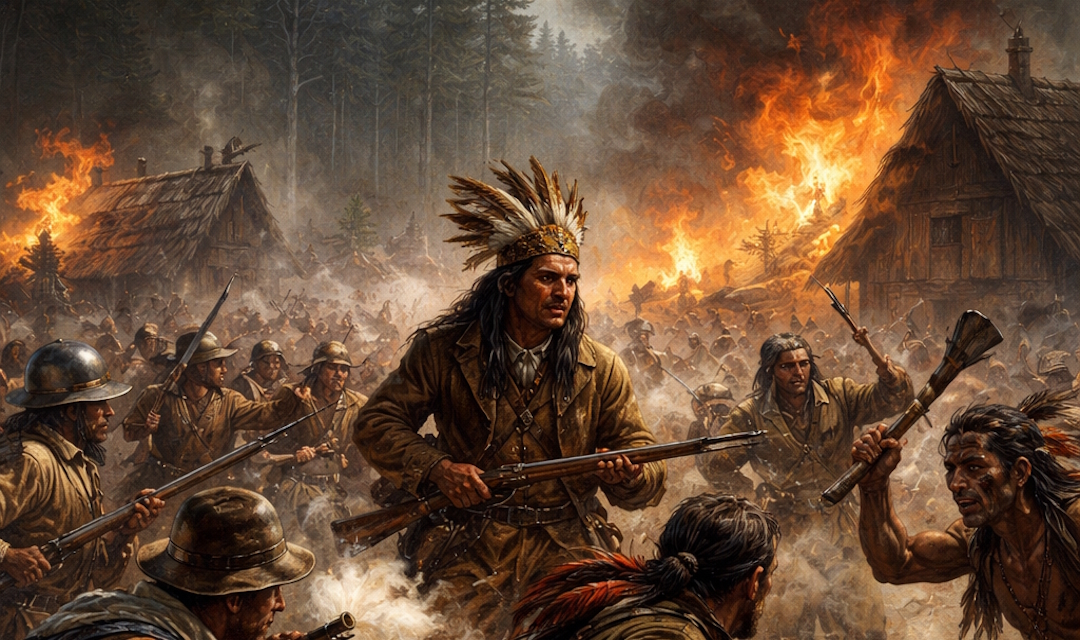
War followed almost immediately, and it spread with remarkable speed. Indigenous forces launched coordinated attacks across the region, targeting settlements in Massachusetts, Rhode Island, and Connecticut. Their strategy was highly effective because it relied on deep knowledge of the environment. Rather than engaging in open battles, they used ambush tactics, attacking quickly and retreating into forests and swamps where English forces struggled to follow. Small, isolated settlements were especially vulnerable. Homes were set on fire, food supplies destroyed, and survivors either killed or captured. These attacks were not random acts of violence—they were strategic efforts to disrupt English expansion and weaken their ability to sustain themselves.
For the English settlers, the psychological impact was devastating. The frontier, once seen as a place of opportunity, became a landscape of constant fear. People lived with the knowledge that attacks could come at any moment, often without warning. Many abandoned their homes and moved into fortified towns, where wooden palisades and armed guards offered some measure of protection. Daily life changed dramatically. Farming became dangerous, trade routes were disrupted, and communication between settlements slowed. The war blurred the line between civilian and soldier, as ordinary people were forced to participate in defense efforts.
Initially, the English struggled to respond effectively. Their traditional military tactics, based on organized formations and direct engagement, were poorly suited to the dense forests and unpredictable nature of the conflict. However, they adapted quickly. Colonial militias became more flexible, forming smaller units capable of moving through difficult terrain. Crucially, they formed alliances with rival Indigenous groups such as the Mohegan and Pequot. These allies provided essential knowledge, including tracking skills and intelligence about enemy movements. This strategy not only improved the effectiveness of English forces, but also fractured Indigenous unity, as tribes found themselves fighting on opposing sides.
As the war progressed, English tactics became increasingly aggressive. The conflict evolved into a form of total war, where the goal was not just to defeat enemy fighters, but to destroy entire communities. Villages were burned systematically, crops destroyed, and food stores targeted to ensure that surviving populations would face starvation. This approach reflected a shift in mindset. The English were no longer seeking coexistence or negotiation—they were fighting for complete dominance.
One of the most significant and brutal events of the war was the Great Swamp Fight in December 1675. Colonial forces tracked a large group of Narragansett people to a fortified village hidden within a frozen swamp. The attack required soldiers to march through harsh winter conditions, including deep snow and icy water. When they reached the village, they encountered strong resistance from defenders positioned behind wooden palisades. After intense fighting, the English breached the defenses and set the village on fire. The result was catastrophic. Hundreds of Indigenous people were killed, including women and children, and many more died later from exposure and starvation after losing their winter supplies. Although the English suffered heavy casualties, the battle marked a turning point, demonstrating their willingness to use overwhelming force to achieve their objectives.
By 1676, the cumulative effects of the war were becoming clear. Indigenous forces faced severe challenges. The destruction of crops and villages had created widespread food shortages, and the harsh winter conditions made survival even more difficult. Alliances began to break down as different groups prioritized their own survival. Some surrendered to the English, while others attempted to negotiate peace independently. Metacom’s coalition, once strong and unified, became fragmented and weakened. Constant pursuit by English forces and their allies made it increasingly difficult to regroup or launch coordinated attacks.
The final phase of the war was marked by the collapse of organized resistance. Metacom was eventually tracked down and killed by a Native ally fighting alongside the English. His death symbolized the end of the war and the failure of Indigenous efforts to resist colonial expansion in the region. In a deliberate act of intimidation, his body was mutilated, and his head was displayed publicly for years. This act served as a warning to others and reinforced the dominance of the English.
The aftermath of King Philip’s War was devastating, particularly for Indigenous communities. Thousands of people were killed, and many survivors were enslaved or forced into servitude. Entire communities were displaced from their ancestral lands, and traditional social and political structures were destroyed. Some captives were sold into slavery in the Caribbean, highlighting the broader economic networks connected to the conflict. For the English, the war also brought significant losses, including destroyed settlements and reduced populations. However, in the long term, they emerged as the dominant force in New England.
The war fundamentally changed the trajectory of the region. It ended any realistic possibility of coexistence based on mutual dependence and fragile cooperation. In its place emerged a system defined by expansion, control, and displacement. English settlements grew more rapidly, and Indigenous resistance was significantly weakened. King Philip’s War was not just a conflict over land or authority—it was a turning point that reshaped the balance of power and set the stage for the continued expansion of colonial America.