The survival of the first European colonies in the Americas was not a matter of chance, nor was it the result of a single decisive factor. It was the outcome of a prolonged and often brutal process of adaptation, negotiation, failure, and gradual learning. Settlements such as Jamestown and early Spanish colonies in the Caribbean and mainland Americas endured because they slowly developed systems that allowed them to cope with unfamiliar environments, limited resources, and constant uncertainty. In their earliest years, these colonies were extremely fragile, frequently on the brink of collapse, and dependent on a combination of Indigenous assistance, maritime logistics, internal reform, and economic restructuring.
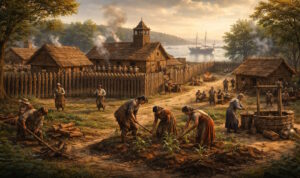
When the English established Jamestown in 1607, the settlers arrived with expectations shaped by European conditions, not by the realities of the Chesapeake environment. They attempted to replicate familiar agricultural practices, but the crops they brought from Europe were poorly suited to the local soil and climate. Many of the colonists were not experienced farmers but gentlemen, soldiers, or craftsmen who lacked the practical knowledge required for subsistence farming. As a result, food production lagged behind consumption almost immediately. This imbalance forced the settlers into a precarious dependence on external support and local cooperation.
A crucial factor in the colony’s survival was its relationship with the Powhatan Confederacy. The Powhatan people possessed deep ecological knowledge of the region, including seasonal food availability, hunting patterns, and agricultural techniques adapted to the environment. Through both trade and occasional diplomacy, they provided the colonists with food supplies such as maize, fish, and game. In return, the colonists offered metal tools, glass beads, and other manufactured goods that were valuable within Indigenous trade networks. This exchange was not always stable or peaceful, but during critical periods it provided the calories necessary for survival. Without this interaction, the colony would likely have failed within its first years.
Even with Indigenous assistance, Jamestown experienced severe crises, the most infamous being the period known as the “Starving Time” during the winter of 1609 to 1610. During this time, the colony was cut off from reliable resupply, relations with the Powhatan had deteriorated, and food stores were exhausted. The result was catastrophic: starvation, disease, and internal collapse reduced the population dramatically. Archaeological and historical evidence suggests that survival during this period often depended on extreme measures, reflecting the desperation of the settlers. This event demonstrated how vulnerable early colonies were when any one element of their survival system failed.
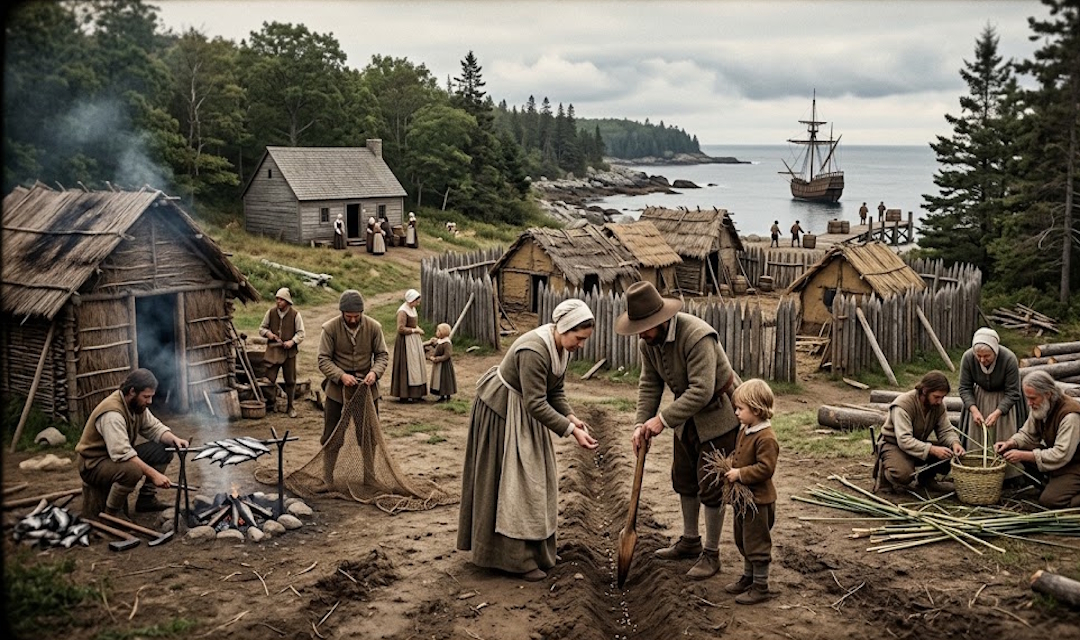
Food preservation techniques also became critical. Colonists adopted methods such as smoking meat, drying fish, and storing grains in elevated or sealed containers to reduce spoilage and protect against rodents and humidity. These practices were not always formally documented but were learned and refined through necessity.
In parallel with local adaptation, transatlantic supply lines played a vital role. Colonies were not self-sustaining entities in their early stages; instead, they functioned as extensions of European economies. Ships arriving from England carried food, livestock, tools, ammunition, and new settlers. These shipments were irregular and vulnerable to delays caused by weather, navigation challenges, and political or economic disruptions. When supplies arrived on time, they could stabilize a colony; when they did not, the consequences were often severe. The ability to maintain consistent maritime connections effectively determined whether a settlement could persist beyond its initial years.
Beyond large-scale systems, survival often depended on small, practical decisions made by individuals and groups. Colonists reused materials extensively, repairing tools and structures rather than replacing them. Clothing was patched repeatedly, and buildings were constructed with locally available timber rather than imported materials.
Food preservation techniques also became critical. Colonists adopted methods such as smoking meat, drying fish, and storing grains in elevated or sealed containers to reduce spoilage and protect against rodents and humidity. These practices were not always formally documented but were learned and refined through necessity.
Over time, economic transformation became the foundation of long-term survival. In Jamestown, the introduction and cultivation of tobacco shifted the colony from a struggling outpost into a profitable enterprise. The work of John Rolfe was particularly significant in developing a strain of tobacco that appealed to European markets. Tobacco cultivation required labor, land expansion, and export infrastructure, which in turn encouraged further migration and investment from England. This created a self-reinforcing economic cycle: profitability attracted settlers, settlers expanded production, and increased production generated more wealth for both the colony and its sponsors.
Leadership and governance also played a decisive role in stabilizing early colonial society. One of the most influential figures in Jamestown’s early years was John Smith, whose strict enforcement of labor discipline helped organize the colony’s workforce. By imposing rules that linked survival to productivity, he reduced disorder and encouraged collective effort in farming, construction, and defense. Such measures were not always popular, but they were necessary in an environment where individual survival depended heavily on communal cooperation. Over time, colonial administrations evolved from loosely organized groups into more structured settlements with defined roles and hierarchies.
Spanish colonial efforts followed a somewhat different trajectory but faced similar fundamental challenges. In regions such as the Caribbean and Mesoamerica, Spanish settlers encountered established civilizations with complex agricultural systems, trade networks, and political structures. Rather than starting from scratch in the same way as Jamestown, Spanish colonies often integrated themselves into existing systems. They relied heavily on Indigenous labor and knowledge while introducing European administrative frameworks. Mining operations, particularly those extracting silver and gold, became central to the Spanish colonial economy, providing immense wealth that supported continued expansion and settlement.
Despite these differences, Spanish and English colonies shared common environmental and biological challenges. European settlers encountered unfamiliar diseases to which they had little or no immunity. Malaria, dysentery, and other illnesses spread rapidly in crowded and unsanitary conditions. Combined with malnutrition and physical exhaustion, disease was one of the leading causes of death in early settlements. Climate also posed difficulties, as settlers had to adapt to different seasonal patterns, humidity levels, and agricultural cycles. Housing, clothing, and daily routines all required adjustment to new environmental realities.
Ultimately, the survival of early colonies depended on a delicate balance of factors. Colonies that managed to establish reliable supply chains, develop economic output, maintain functional leadership, adapt to local ecological conditions, and build relationships—whether cooperative or exploitative—with Indigenous populations had a significantly higher chance of persistence. Those that failed to achieve this balance often collapsed due to starvation, conflict, disease, or isolation.
The history of early colonial survival reveals that these settlements were not immediately successful ventures but fragile experiments in human adaptation. Their endurance was the result of continuous trial and error, shaped by both cooperation and conflict, and driven by the necessity to transform unfamiliar and often hostile environments into habitable and productive societies.