
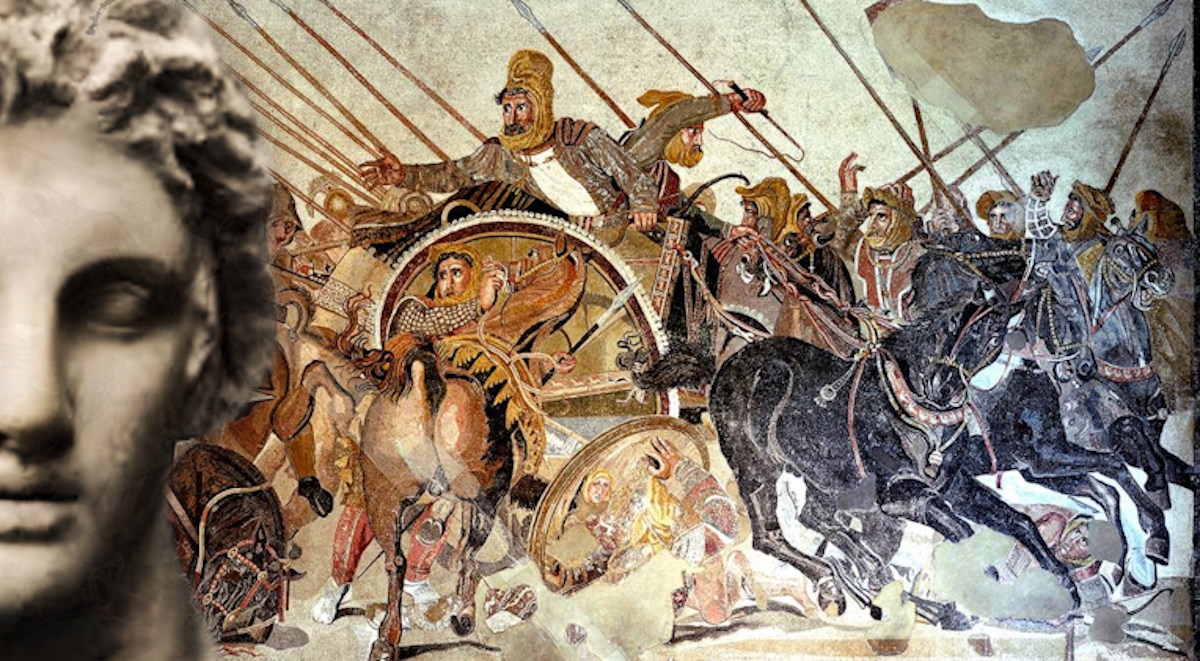
Alexander the Great is often remembered as a brilliant conqueror, but his rise to power was marked early by calculated violence. When Thebes rebelled in 335 BC, he responded with overwhelming force, destroying the city almost entirely. Thousands were killed, and tens of thousands sold into slavery. This was not just retaliation—it was a deliberate act of terror meant to secure obedience across Greece, showing that his rule would be maintained through fear as much as loyalty.
His campaign against Tyre revealed an even harsher edge. After a grueling siege, Alexander ordered mass executions and crucifixions along the shoreline. Ancient sources describe thousands killed and many more enslaved. The brutality was systematic and public, transforming a military victory into a spectacle of punishment. It demonstrated that resistance to him would not just be defeated—it would be annihilated in ways meant to leave a lasting psychological scar.
The destruction of Persepolis stands as one of the most symbolic acts of his darker impulses. The city, a cultural and ceremonial heart of the Achaemenid Empire, was burned—possibly during a drunken celebration. While some framed it as revenge for earlier Persian invasions, the act also erased an irreplaceable center of art, history, and identity. It raises the question of whether Alexander was motivated by strategy, emotion, or a growing sense of unchecked power.
As his empire expanded, so did signs of paranoia. The execution of Parmenion, one of his most loyal and experienced commanders, marked a turning point. Without a fair trial, Parmenion was killed after his son was accused of conspiracy. This decision reflected a shift in Alexander’s leadership—from trust and camaraderie to suspicion and preemptive elimination. Loyalty was no longer protection against his fear of betrayal.
One of the most personal and tragic episodes was the killing of Cleitus the Black. During a drunken argument, Cleitus criticized Alexander’s increasing adoption of foreign customs and his growing arrogance. In a fit of rage, Alexander killed the very man who had once saved his life in battle. Though he later expressed deep regret, the act exposed a volatile temperament and a dangerous inability to control his impulses when challenged.
Alexander’s adoption of Persian royal customs further deepened the divide between him and his Macedonian followers. He began to demand forms of reverence, including gestures that implied divine status. To many Greeks and Macedonians, this was deeply offensive, as they viewed such acts as reserved for gods, not men. His insistence on these practices suggested not only political adaptation but also a shift in self-perception—one that blurred the line between king and deity.
A defining trait of Alexander the Great was his overwhelming ambition, which seemed to grow with every victory. Early in his career, this drive made him bold and innovative, but over time it became insatiable. Conquering the Achaemenid Empire was not enough—he pressed onward into Central Asia and toward India, chasing what appeared to be an endless horizon of conquest. This relentless pursuit suggests a man who could not accept limits, even when his army was exhausted and his empire already vast beyond precedent.
Closely tied to this ambition was a deep need for recognition and glory. Alexander was heavily influenced by heroic ideals, particularly those found in works like the Iliad, and he consciously modeled himself after figures such as Achilles. This desire to be remembered as more than human may have fueled both his courage and his recklessness. It wasn’t enough to succeed—he needed to be legendary, and that mindset often pushed him toward extreme decisions that prioritized legacy over stability or compassion.
Another striking aspect of his character was emotional intensity, which could quickly shift from charisma to volatility. He inspired fierce loyalty among his troops, often fighting alongside them and sharing their hardships. Yet this same emotional depth could erupt into destructive anger, as seen in moments like the killing of Cleitus the Black. His inability to regulate these extremes made him both magnetic and dangerous—capable of deep bonds, but also sudden, irreversible violence.
Alexander also exhibited a growing sense of isolation as his reign progressed. Surrounded by power and increasingly treated as divine, he became distanced from those who had once been his equals. The execution of trusted figures like Parmenion reflects not only paranoia but also a ruler who no longer felt secure even among loyal companions. This isolation likely intensified his suspicion, creating a cycle where fear led to harsher decisions, which in turn deepened his separation from others.
Ultimately, Alexander’s character seems marked by contradiction: visionary yet destructive, charismatic yet feared, brilliant yet impulsive. His psychological transformation—from a bold young king to a ruler who saw himself as godlike—suggests that absolute power reshaped his identity in profound ways. In this sense, his dark side is not just a collection of violent acts, but a portrait of a man gradually consumed by his own ambition, myth, and the immense weight of the empire he created.