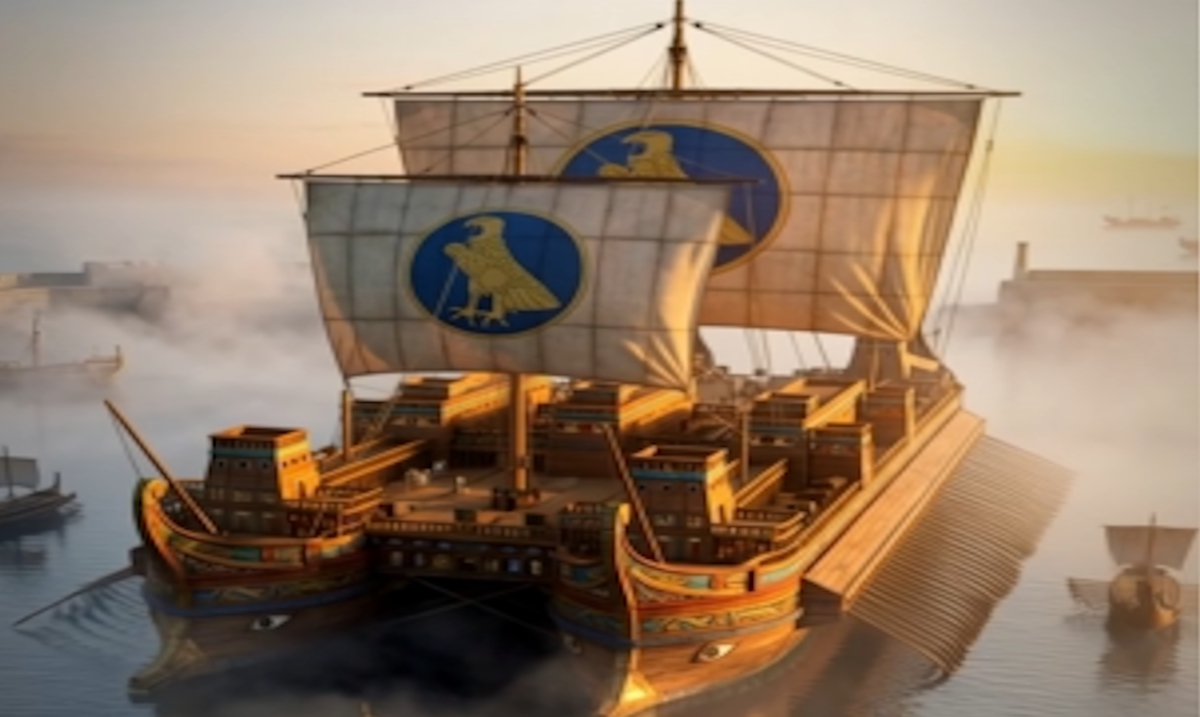
Among the many remarkable engineering feats of the ancient world, few are as astonishing as the Tessarakonteres, a massive warship reportedly constructed during the reign of Ptolemy IV Philopator in the 3rd century BCE. Its name comes from the Greek word meaning “forty”, referring to its extraordinary rowing arrangement. Ancient writers described it as a vessel of almost unimaginable scale—so large that even modern historians debate whether it could truly have functioned as a practical ship. Whether exaggerated or not, the Tessarakonteres remains one of the most extraordinary examples of the ambition and technological experimentation of the Ptolemaic Kingdom.
A Ship of Enormous Dimensions
The main description of the Tessarakonteres comes from the Greek historian Callixenus of Rhodes, whose account survives through the later writer Athenaeus. According to these records, the ship measured approximately 128 meters (420 feet) long and about 17 meters (55 feet) wide. To put this into perspective, a typical ancient warship such as a trireme was only about 35 meters long, meaning the Tessarakonteres may have been nearly four times larger than the standard naval vessels of its time.
The ship was said to require a staggering number of people to operate it. Ancient descriptions suggest around 4,000 rowers, in addition to hundreds of sailors and soldiers. If accurate, this would make it not only the largest ship in the ancient Mediterranean but also one of the largest human-powered vessels ever conceived.
The Meaning of “Forty-Oared”
The name Tessarakonteres has often caused confusion. It does not mean the ship literally had forty oars. Instead, the number refers to the complex system of rowers arranged in multiple tiers. Ancient warships were often classified by the number of rowers working together in each vertical section of oars. A “five,” for example, had five rowers per section.
In the case of the Tessarakonteres, the “forty” likely referred to forty men operating the oars in each vertical unit, spread across several levels. This means the vessel probably had a vast array of rowing stations stacked in tiers along its enormous hull. Coordinating such a system would have required extraordinary discipline and synchronization among the rowers.
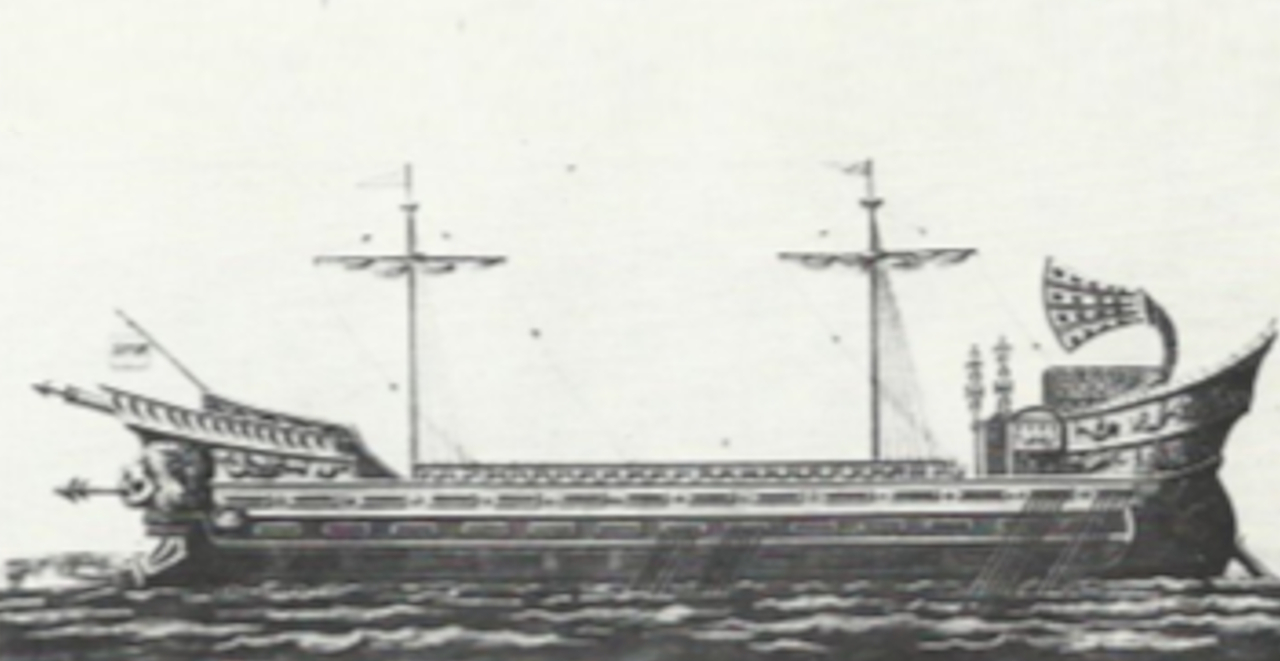
Some scholars believe the ship may actually have been constructed with two parallel hulls joined together, somewhat similar to a giant catamaran. This design could have provided the structural stability needed to support its enormous size and the weight of thousands of crew members.
Engineering Challenges
Building a ship of this size in the ancient world would have presented enormous engineering challenges. Wooden ships rely heavily on the structural strength of their hulls, and as vessels grow larger, the stresses on the wooden beams increase dramatically. The Tessarakonteres would have required massive timbers, complex internal bracing, and careful weight distribution to prevent the hull from warping or splitting.
Another difficulty would have been steering. Even large ships in later centuries struggled with maneuverability, and a vessel of this scale powered by thousands of rowers might have been extremely difficult to control in rough seas. Because of these problems, many historians suspect that the ship was not intended for combat but rather as a demonstration of technological prowess and royal prestige.
More Fascinating Facts About the Tessarakonteres
Historians and naval engineers continue to debate how such a vessel could have been built and operated over two thousand years ago. Here are some intriguing facts that reveal just how remarkable this ancient “supership” may have been.
1. Possibly the Largest Human-Powered Vessel Ever Built
If ancient descriptions are accurate, the Tessarakonteres may have been the largest ship ever powered entirely by human rowers. With an estimated 4,000 rowers, plus sailors and soldiers, the total number of people on board could have exceeded 6,000 individuals. That is roughly the population of a small ancient town floating on a single ship.
2. It May Have Had Two Hulls
Some modern scholars believe the ship may have been constructed using two parallel hulls connected by a massive platform. This design would resemble a gigantic catamaran and would help stabilize the enormous structure. Without such a design, a wooden ship of this size might have been too unstable or prone to structural failure.
3. Rowers Had Extremely Long Oars
Because the ship was so wide and tall, the oars used by the rowers would have been unusually long—possibly over 10 meters (33 feet). Handling such massive oars required several men working together in coordination, making rowing a highly organized and physically demanding task.
4. Coordination Was a Huge Challenge
To move efficiently, thousands of rowers had to pull their oars in perfect rhythm. Ancient ships used musicians—often drummers or flute players—to maintain rowing tempo. On a ship the size of the Tessarakonteres, coordinating the rhythm may have required multiple musicians or signal systems across the decks.
5. It Was Probably Too Slow for Battle
Despite being labeled a warship, the Tessarakonteres was likely too large and slow to function effectively in combat. Smaller ships such as triremes were fast and maneuverable, designed to ram enemy vessels. The giant size of the Tessarakonteres would have made quick turns almost impossible.
Because of this, historians believe it was probably used for ceremonial or prestige purposes rather than real naval warfare.
6. It Was a Floating Demonstration of Power
During the Hellenistic era following Alexander the Great, rival kingdoms tried to outdo one another with grand projects. The ruler who built the Tessarakonteres, Ptolemy IV Philopator, likely intended the ship as a symbol of wealth, engineering mastery, and royal authority.
Imagine foreign ambassadors seeing such a colossal vessel anchored in the harbor—it would have been an unforgettable display of power.
7. It Might Have Had Ballistae and Catapults
Some ancient accounts suggest the ship was equipped with large artillery weapons, including ballistae and catapults. These machines could launch heavy bolts or stones at enemy ships or coastal targets. However, whether the vessel ever used them in battle is uncertain.
8. The Ship May Have Had Multiple Decks
Descriptions indicate that the Tessarakonteres had several decks stacked above the rowers, possibly including observation platforms, fighting positions for soldiers, and luxury areas for officials or the king. The structure may have looked more like a floating fortress than a traditional warship.
9. It Was Likely Built Near Alexandria
The ship was probably constructed near Alexandria, the capital of the Ptolemaic Kingdom. Alexandria was one of the most advanced cities of the ancient world, famous for its massive harbor and the towering Lighthouse of Alexandria. This harbor would have been one of the few places large enough to accommodate such an enormous vessel.
10. It May Have Inspired Later Giant Ships
The idea of building gigantic prestige vessels did not disappear after the Tessarakonteres. Centuries later, the Roman emperor Caligula constructed enormous luxury ships on Lake Nemi, complete with marble floors, baths, and advanced technology. These Roman ships were discovered in the 20th century and provide some evidence that ancient engineers truly attempted monumental shipbuilding projects.
11. Ancient Writers Were Amazed by It
Writers such as Athenaeus preserved detailed descriptions of the Tessarakonteres because it impressed people even in antiquity. To them, it represented the ultimate achievement of naval engineering.
12. It May Never Have Left the Harbor
Because of its enormous size and complexity, some historians believe the Tessarakonteres rarely sailed far from port. It may have been used mainly for ceremonial cruises or simply displayed as a technological marvel.