In the early years of global exploration, Christopher Columbus’s letters about his voyages stand as among the earliest European descriptions of lands that would later be known as the Americas. The most famous of these is the letter he wrote in February 1493 to King Ferdinand and Queen Isabella of Spain, shortly after completing his first transatlantic journey (1492–1493). This letter was not only a report of his discoveries but also a political document designed to secure continued support for further exploration. Its publication and rapid distribution across Europe helped reshape European understanding of world geography and sparked the Age of Discovery.
Background: Why Columbus Wrote the Letter
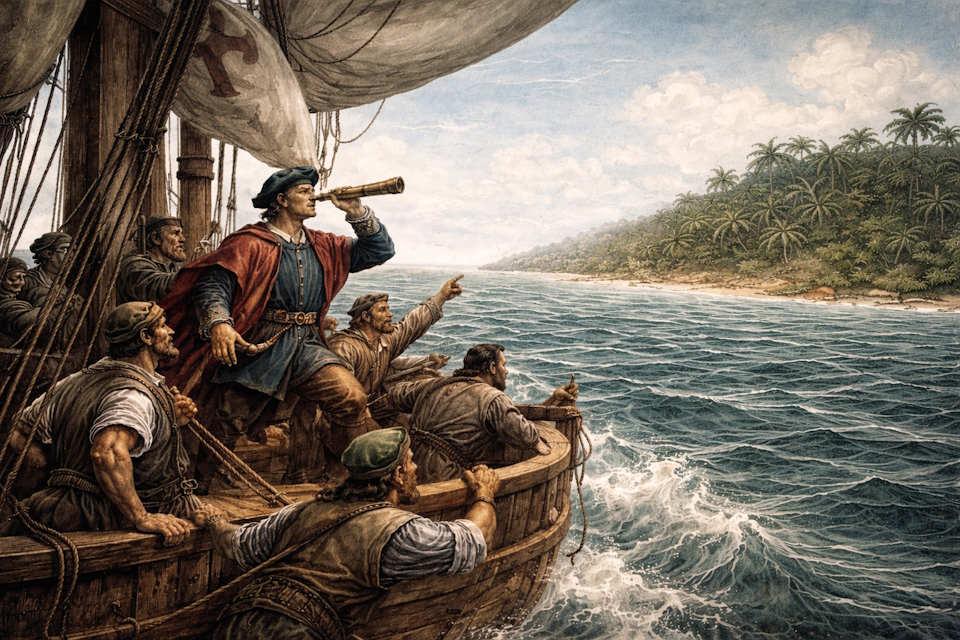
Christopher Columbus embarked on his first voyage in August 1492 from Palos de la Frontera in Spain, under the patronage of the Catholic Monarchs, King Ferdinand II of Aragon and Queen Isabella I of Castile. The goal was to find a westward sea route to Asia—the “Indies”—to access valuable spices and trade goods. Instead of reaching Asia, Columbus encountered previously unknown islands in the Caribbean. Believing he was near Asia’s eastern periphery, he set out on the return voyage to Spain, eager to announce his findings to the sovereigns who had funded the expedition.
While aboard the caravel Niña during the homeward journey, Columbus composed a letter describing his discoveries, detailing the lands, peoples, and natural resources. A postscript was added when he reached Lisbon on March 4, 1493, and from there he dispatched copies to the Spanish court.
The Letter: Announcement of Discoveries
Columbus’s letter begins by addressing the success of his mission and acknowledging that his audience—the monarchs—would be pleased by the news. From the outset, he emphasizes his loyalty and service to the Crown and frames his discoveries as a divine blessing bestowed through holy guidance.
In vivid terms, he reports that in thirty‑three days of sailing he reached a “sea of the Indies” and discovered a “great many islands inhabited by numberless people.” He states that he took possession of all these lands on behalf of the Spanish Crown by proclamation and by unfurling the royal standard, without encountering resistance from local inhabitants.
Columbus proceeds to name the islands, assigning new names that honored his monarchs and the divine. The first island was named San Salvador in thanksgiving; others included Santa Maria de la Concepcion, Fernandina, Isabella, and Juana. Throughout, he expresses gratitude to God for the successful voyage and the discoveries made under His providence.
Descriptions of Land and Environment
The letter contains extended passages describing the geography and natural environment of these newly encountered islands. Columbus wrote of their vastness and fertility, noting broad rivers, lush vegetation, and numerous safe harbors. For example, in describing the island of Juana (likely Cuba), he notes its extensive coastline and fertile soil, imagining that it might be part of the Asian mainland.
Columbus’s descriptions often convey a blend of wonder and speculation. He seeks to understand the physical geography and to interpret what he has seen through the lens of European geographical expectations. At times, he even speculates that the mainland of Asia must lie nearby, not realizing that he had encountered an entirely new continent.
The Peoples Columbus Encountered
A major part of Columbus’s letter is devoted to his encounters with the native peoples of the Caribbean. He refers to them as “Indians,” a term that would endure long after he realized he had not reached Asia. Columbus’s description emphasizes their lack of advanced weapons and what he perceived as their docility and openness to Christianity.
He writes that the inhabitants were “timid and full of terror,” possessing no iron or steel and no complex weaponry. He portrays them as innocent and honest, lacking governance systems comparable to European states. Importantly, Columbus frames this as an opportunity: he suggests that the native peoples “might easily be made Christians and inclined to love our King and Queen.”
These descriptions reflect both Columbus’s worldview and his objectives—in essence, to present the potential for religious conversion and political control back to the monarchs. They also shaped early European perceptions of Indigenous peoples as pliant and conquerable, contributing to narratives that would fuel colonization in the years that followed.
Prospects of Wealth and Future Exploration
Another crucial component of the letter is Columbus’s focus on potential wealth, which he emphasizes to secure further support and funding. He alludes to reports of abundant natural resources, including fertile lands and, importantly, gold. Columbus’s suggestion that gold might be obtained with relative ease appealed directly to the Spanish Crown’s economic and political interests.
Columbus also notes that during his exploration he did not encounter the large cities of Asia he had hoped to find—but he suggests that further voyages would likely reveal more. His intention in the letter is explicit: to encourage the monarchs to support additional expeditions that could extend European reach deeper into these newly encountered lands.
Religious and Political Framing
Throughout the letter, Columbus frames his discoveries within the context of divine purpose and Christian mission. He expresses his belief that his voyage and its success are part of God’s larger plan. This religious justification served multiple purposes: it acknowledged the Catholic faith of his patrons, aligned his mission with the spread of Christianity, and reinforced the Crown’s interest in both spiritual and temporal power.
By presenting the voyage as a holy endeavor aimed at expanding Christendom, Columbus also positioned the discoveries as morally and politically righteous. This framing would resonate deeply in a Europe still shaped by religious identity and the reconquest of Iberian territories in the Reconquista.
Publication and Spread Across Europe
Once Columbus returned to Spain in March 1493, copies of the letter were rapidly disseminated throughout Europe, thanks in large part to the developing technology of the printing press. Versions were printed in Spanish, Latin, and other languages; translations and reprints appeared in Basel, Paris, Antwerp, and other centers of European printing.
The letter’s wide circulation made it one of the first widely read printed documents announcing the discovery of the New World. It effectively became a bestseller of its time, with historians estimating that thousands of copies were printed within the first year after its release. For many Europeans, this letter was their first encounter with the idea that unknown lands lay across the Atlantic Ocean.
Long‑Term Impact and Legacy
Columbus’s 1493 letter had profound effects on the course of world history. Its publication helped ignite the Age of Discovery, encouraging other European explorers and monarchs to pursue their own voyages across the Atlantic. The sense of possibility—whether for wealth, strategic advantage, or religious conversion—would motivate Spain, Portugal, France, England, and others to establish colonies in the Americas.
The letter also shaped early European perceptions of Indigenous peoples, often portraying them as receptive to conversion and easy to govern—ideas that would justify, in European minds, the expansion of colonial rule and the spread of Christianity.
Although Columbus believed he had reached Asia, the lands he described marked the beginning of European recognition of the American continents. It would take years, and the work of later explorers, to fully understand the geographic reality of these new territories—but the 1493 letter stands as the first public document to announce their existence to Europe.
Conclusion: A Foundational Document of the New World
Christopher Columbus’s February 1493 letter to King Ferdinand and Queen Isabella is both a primary historical source and a foundational document in the story of European expansion. It blends geographic observation, ethnographic description, political advocacy, and religious rhetoric, reflecting both Columbus’s ambitions and the broader motives of his sponsors.
While Columbus did not realize he had encountered a new continent, his letter made that encounter known throughout Europe and set in motion a wave of exploration, conquest, and cultural exchange—often with devastating consequences for Indigenous peoples. The letter stands as a testament to the transformative power of written communication in shaping global history—a single document that helped usher in a new era, remembered both for its historical importance and for the complex legacy it began.